Why vows matter – and why they feel hard
A wedding vow is the moment you turn a promise into a public promise. It’s the one line (or several) that will be replayed at anniversaries, tucked into photo albums, and sometimes whispered in quiet moments years later. Because the words are meant to capture both the intimacy of your relationship and the seriousness of the commitment, many people freeze at the thought of writing them. The pressure comes from three sources: fear of sounding cliché, uncertainty about length, and the desire to honor both partner and ceremony without over‑talking. The good news is that a vow can be as simple or as elaborate as you need, as long as it follows a clear thought process and a modest structure.
Step by Step
- Gather your story material – Spend 10‑15 minutes alone with a notebook or a digital document. Jot down three concrete moments that define your relationship: the first time you realized you loved them, a challenge you overcame together, and a small habit that makes you smile. These anchors will keep your vow grounded in reality.
- Define the core promise – Ask yourself, “What am I promising to do every day, for the rest of my life?” Write the promise in a single sentence. Example: “I promise to listen to you even when I’m tired.” This sentence becomes the spine of the entire vow.
- Choose a tone that matches the ceremony – If the ceremony is formal, aim for language that is respectful yet personal (e.g., “I shall honor…”). If it’s casual, feel free to use humor or colloquial phrasing (“I’ll always steal the covers”). Write a short paragraph describing the tone; refer back to it while drafting to avoid accidental shifts.
- Draft a rough version – Using the three story moments, weave them around the core promise. Keep each anecdote to one or two sentences. A good rule of thumb: 150‑200 words total (roughly 1 minute spoken).
- Trim the excess – Read the draft aloud. Count the breaths you need; if you exceed 12‑15 breaths, cut a sentence or replace a phrase with a stronger verb. Replace filler (“I think,” “I feel”) with concrete actions (“I will,” “I will stand”).
- Get feedback from a trusted ear – Share the trimmed version with a friend who knows both you and your partner but isn’t involved in the ceremony. Ask three specific questions: (a) Does the tone feel authentic? (b) Is the core promise clear? (c) Is any part overly generic? Incorporate only the feedback that aligns with your voice.
- Finalize and rehearse – Write the final version in a legible script (hand‑written or printed on thick paper). Practice it three times: once silently, once with a natural speaking pace, and once with a slight pause before each major clause. This rehearsal will reveal any lingering tongue‑twisters and help you internalize the rhythm.
A Simple Structure to Follow
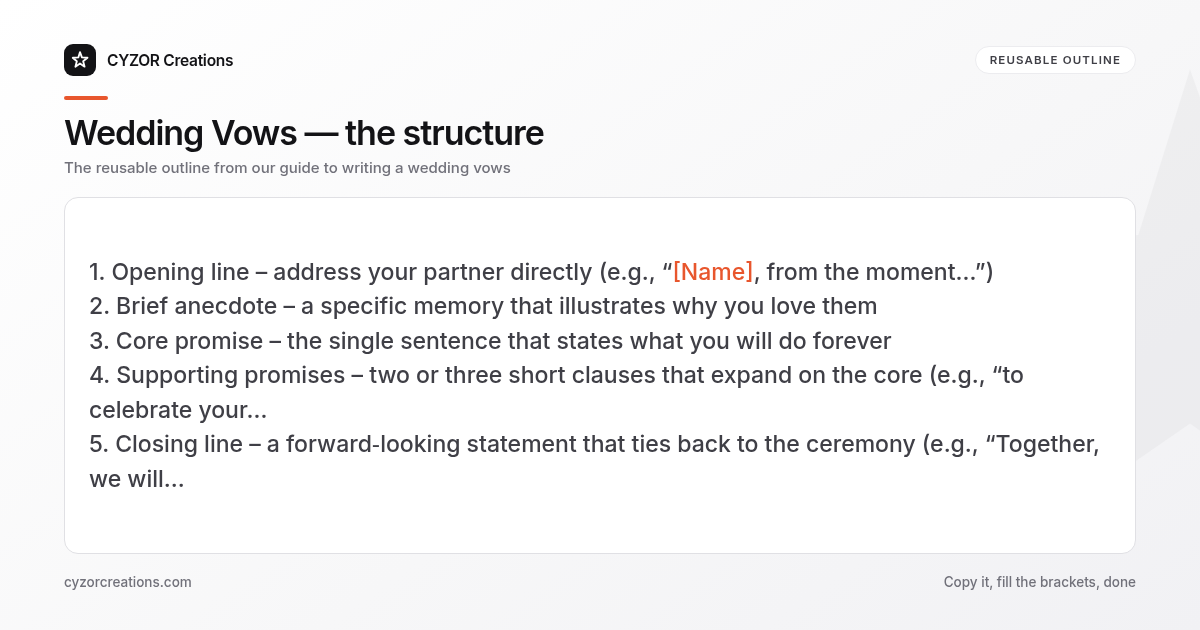
1. Opening line – address your partner directly (e.g., “[Name], from the moment…”)
2. Brief anecdote – a specific memory that illustrates why you love them
3. Core promise – the single sentence that states what you will do forever
4. Supporting promises – two or three short clauses that expand on the core (e.g., “to celebrate your victories, to hold you through doubts”)
5. Closing line – a forward‑looking statement that ties back to the ceremony (e.g., “Together, we will write the rest of our story”)
Feel free to swap the order of the anecdotes and promises, but keep the opening and closing lines as bookends. This template keeps the vow under one minute while still feeling complete.
Common Mistakes to Avoid
- Relying on clichés – “You are my sunshine” or “I will love you till the end of time” sound rehearsed unless you attach a personal twist.
- Over‑loading with details – Listing every favorite restaurant or inside joke crowds the main promise.
- Changing the promise mid‑speech – Introducing a new vow after the core sentence confuses the listener.
- Speaking in a monotone – Even the most heartfelt words lose impact without natural pauses and emphasis.
- Leaving the vow unwritten – Memorizing a vow you haven’t seen on paper can lead to stumbling or forgetting key lines.
A Short Example
> Emily, when I first saw you laughing at the rain‑soaked street market, I realized I wanted a lifetime of moments that felt that bright. I promise to keep our kitchen a place where we can experiment with new recipes, even if the smoke alarm goes off. I will listen to your dreams, support your ambitions, and hold your hand through every storm. Together, we will build a home that feels like a safe harbor, no matter where life takes us.
This excerpt follows the template: opening address, anecdote, core promise, supporting promises, and a forward‑looking close. It stays under 150 words and uses concrete images rather than abstract platitudes.
Pro Tips
- Use “I will” instead of “I hope” – Commitment is stronger when expressed as an action, not a wish.
- Anchor each promise with a sensory detail – “I will taste the coffee you brew each morning” paints a vivid picture and makes the vow memorable.
- Practice with a timer – Aim for 60 seconds; if you’re consistently under, add a line; if you’re over, cut a non‑essential detail.
- Write the vow on the day of the ceremony – A fresh mind often captures emotions more honestly than a draft written months earlier.
- Leave a tiny pause before the core promise – This natural break signals to the audience that the most important part is coming, increasing its impact.