Why a Eulogy Matters – and What Makes It Hard
A eulogy is more than a speech; it’s a bridge between grief and memory. It lets the living hear the person’s story in a way that feels both intimate and public. Most people stumble because they’re asked to speak at a moment when emotions run high, and because they lack a clear roadmap for turning memories into a coherent tribute. The pressure to “get it right” often leads to either a rambling recollection or a sterile list of achievements. This guide cuts through the anxiety by giving you a concrete process, a reusable template, and the pitfalls to watch out for.
Step by Step
- Gather Core Material (30 min – 1 hr)
- Talk to two or three close relatives or friends. Ask them for one vivid anecdote that captures the honoree’s character.
- Pull together any written material you already have: letters, birthday cards, social‑media posts, or a favorite poem.
- Jot down dates, places, and roles (e.g., “first job at XYZ Co.”) that you’ll need for factual anchors.
- Identify the Central Theme (15 min)
- Look for a thread that appears in the stories you collected: generosity, humor, perseverance, etc.
- Phrase the theme as a short statement, such as “She taught us that kindness is a daily practice.” This will be the emotional spine of your eulogy.
- Draft a Rough Outline (10 min)
- Use the template in the next section. Fill in each bullet with a single sentence or phrase.
- Keep the outline to 5–7 points; more than that dilutes focus.
- Write the First Full Draft (45 min – 1 hr)
- Expand each outline point into a paragraph. Aim for 150–200 words total.
- Start with a hook—a brief, vivid image or a surprising fact—to draw listeners in.
- Sprinkle in the anecdotes you collected, linking them back to the central theme.
- Trim and Polish (20 min)
- Read the draft aloud. Delete any sentence that doesn’t advance the theme or add a concrete detail.
- Replace vague adjectives (“nice,” “good”) with specific descriptors (“patient,” “sharp‑witted”).
- Ensure the speech flows naturally: each paragraph should lead logically to the next.
- Practice with Timing (15 min)
- Aim for 4–6 minutes when spoken at a moderate pace (≈130 words per minute).
- Mark natural pauses for breaths or brief silences after especially emotional lines.
- If you’re nervous, rehearse in front of a trusted friend and ask for one piece of feedback.
- Finalize Logistics (5 min)
- Print a double‑spaced copy on cardstock; highlight the first line of each paragraph.
- If you’ll use a podium, test the microphone beforehand.
- Keep a backup copy on your phone or in a small notebook.
A Simple Structure to Follow
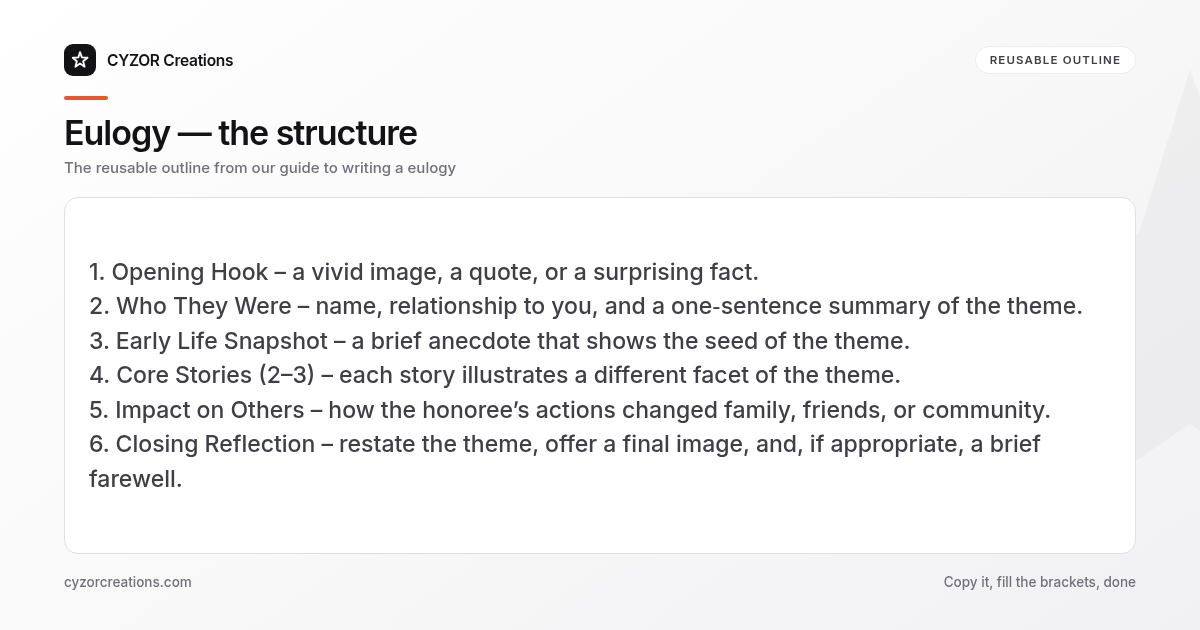
1. Opening Hook – a vivid image, a quote, or a surprising fact.
2. Who They Were – name, relationship to you, and a one‑sentence summary of the theme.
3. Early Life Snapshot – a brief anecdote that shows the seed of the theme.
4. Core Stories (2–3) – each story illustrates a different facet of the theme.
5. Impact on Others – how the honoree’s actions changed family, friends, or community.
6. Closing Reflection – restate the theme, offer a final image, and, if appropriate, a brief farewell.
How to fill it in:
- Opening Hook: “When I think of Uncle Joe, I picture him standing at the kitchen sink, humming while he fixed a leaky faucet that had plagued the house for months.”
- Who They Were: “Joe Miller, my brother’s best friend, was the kind of person who turned every problem into a lesson in patience.”
- Early Life Snapshot: “As a child in a small town, he spent Saturdays delivering newspapers, learning the value of showing up even when the sky was gray.”
- Core Stories:
- The Midnight Shift – how he stayed late at the hospital to comfort a grieving family.
- The Garden Project – how he transformed a vacant lot into a community garden.
- The Birthday Surprise – how he organized a surprise party for a friend who thought no one remembered his birthday.
- Impact on Others: “Because of Joe, the garden now feeds twenty families each summer, and the hospital staff still talk about his calm presence during the toughest nights.”
- Closing Reflection: “If we carry forward his habit of showing up, we’ll keep his spirit alive every time we turn a wrench, plant a seed, or simply listen.”
Common Mistakes to Avoid
- Listing achievements without context – “He won three awards” tells nothing about why those awards mattered to the people he touched.
- Over‑loading with dates and names – a string of years and titles makes the speech feel like a résumé.
- Using clichés – phrases like “He will be missed by all” dilute emotional impact.
- Reading the speech verbatim without pauses – a monotone delivery erases the intimacy of personal stories.
- Ending on a somber note – a eulogy should leave listeners with a sense of continuity, not just grief.
A Short Example
> “When I was ten, my grandfather took me to the county fair. He didn’t buy me a prize; instead, he spent the whole afternoon teaching me how to toss a ring onto a bottle. He missed every shot, but his laughter never faltered. That day, I learned that success isn’t measured by the trophy you bring home, but by the joy you share while trying. Granddad’s habit of turning ordinary moments into lessons stayed with me long after the fair lights dimmed. Today, as we gather to remember him, I see his spirit in the way we all smile at each other’s stories, just as he taught me to smile at my own missed rings.”
Pro Tips
- Anchor the speech with a sensory detail. Mention a smell, a sound, or a texture that instantly transports listeners to a memory.
- Use a “call‑and‑response” pause. After a poignant line, pause for a breath; the silence lets the words settle.
- Write in the present tense for vividness. “He walks into the room” feels more immediate than “He walked into the room.”
- Keep a “fallback sentence” ready. If you lose your place, a simple line like “I’m grateful for the chance to share his story” buys you a moment to regroup.
- End with a concrete action. Suggest a small tribute—planting a seed, lighting a candle, or sharing a favorite recipe—so the audience can carry the memory forward.