Why a Good Toast Matters (and What Trips People Up)
A toast is more than a quick “cheers.” It marks a milestone, signals respect, and can set the emotional tone for the whole gathering. Most people stumble because they try to improvise under pressure, worry about saying the wrong thing, or simply don’t know how to shape a few minutes of speech into something memorable. The good news is that a toast follows a predictable rhythm, and with a handful of tools you can craft one that feels sincere, stays on point, and lands with the audience.
Step by Step
- Clarify the purpose and audience
- Write down the event (wedding, retirement, birthday) and who will be listening.
- Ask yourself: What does the honoree want to hear? and What does the crowd need to feel?
- Jot a one‑sentence purpose statement, e.g., “Celebrate Maya’s 30‑year career and inspire her next chapter.”
- Gather concrete details
- Pull three specific anecdotes that illustrate the purpose.
- Choose moments that are vivid (a funny mishap, a turning point, a quiet act of kindness).
- Verify names, dates, and locations; a single factual slip can undermine credibility.
- Draft a skeleton
- Use the template in the next section (opening → story → lesson → toast).
- Plug each anecdote into the appropriate slot; keep each story under 30 seconds when spoken.
- Write the full text
- Aim for 150–200 words total (roughly 1–2 minutes).
- Use short sentences for emphasis, and vary rhythm with a few longer, reflective lines.
- Insert a pause cue (e.g., “pause for a sip”) to control pacing.
- Edit for clarity and tone
- Read aloud; delete filler words (“you know,” “actually”).
- Check that the tone matches the occasion—warm for a family gathering, polished for a corporate event.
- Ensure the final line ends with a clear invitation to raise glasses.
- Practice with a timer
- Record yourself or rehearse in front of a mirror.
- Aim for 60–90 seconds; trim any segment that pushes you past the limit.
- Note where you naturally breathe; those spots become natural pauses.
- Prepare for the moment
- Write the final version on a small card or index card; highlight the opening line and the final “cheers.”
- Arrive early, locate the microphone (if any), and test the volume.
- Take a deep breath, make eye contact with the honoree, and deliver.
A Simple Structure to Follow
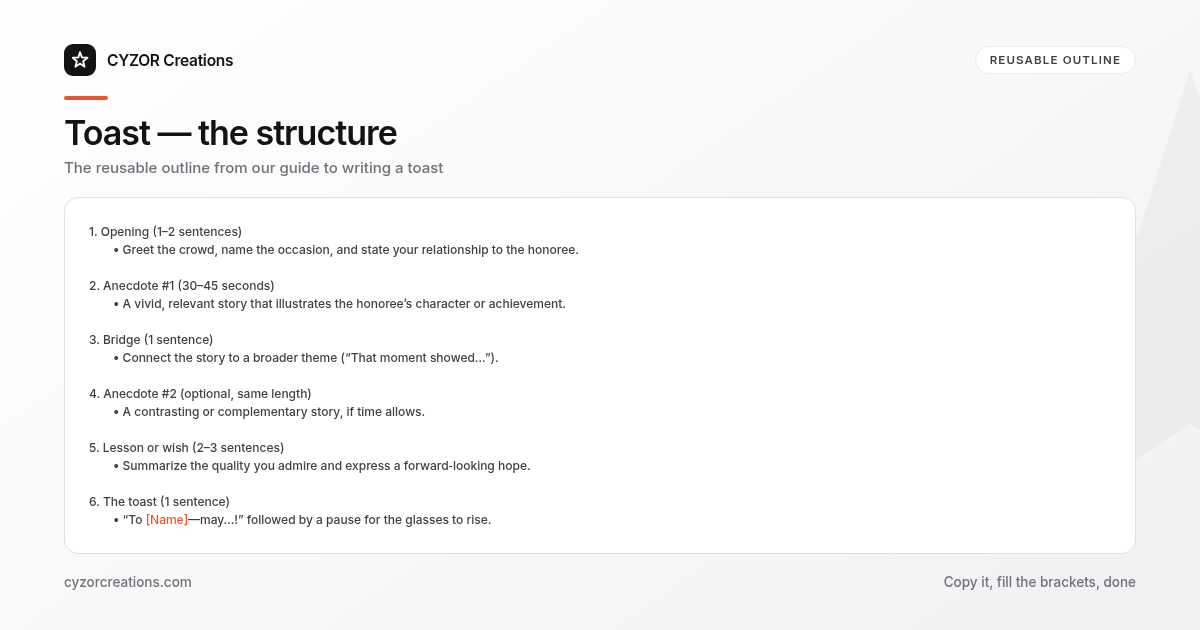
1. Opening (1–2 sentences)
   • Greet the crowd, name the occasion, and state your relationship to the honoree.

2. Anecdote #1 (30–45 seconds)
   • A vivid, relevant story that illustrates the honoree’s character or achievement.

3. Bridge (1 sentence)
   • Connect the story to a broader theme (“That moment showed…”).

4. Anecdote #2 (optional, same length)
   • A contrasting or complementary story, if time allows.

5. Lesson or wish (2–3 sentences)
   • Summarize the quality you admire and express a forward‑looking hope.

6. The toast (1 sentence)
   • “To [Name]—may…!” followed by a pause for the glasses to rise.
Feel free to swap the order of the anecdotes or replace the second story with a brief quote from a close friend. The key is that each element serves a purpose: hook, evidence, reflection, and call to celebrate.
Common Mistakes to Avoid
- Rambling about unrelated topics – Stick to the purpose; a stray comment dilutes impact.
- Over‑loading with jokes – One well‑timed laugh is enough; too many can feel forced.
- Reading a script verbatim – It sounds rehearsed; aim for a conversational cadence.
- Neglecting the audience – Forgetting to address the broader group makes the toast feel self‑centered.
- Ending without a clear cue – If the final line doesn’t signal “raise your glass,” listeners may be left hanging.
A Short Example
> “Good evening, everyone. I’m Sam, Maya’s teammate of eight years, and I’ve had the privilege of watching her turn every challenge into a lesson. I still remember the night she stayed late to debug the server crash—while the rest of us were already home. She didn’t just fix the code; she taught us how to stay calm under pressure. That calm has become the hallmark of her leadership. Maya, may the next chapter bring you as much curiosity and joy as the first. To Maya—cheers!”
Notice the tight word count, the single vivid anecdote, and the direct invitation to lift glasses.
Pro Tips
- Use a “signature line.” End every toast with a short, repeatable phrase (“To love, laughter, and lasting memories”) that becomes your personal hallmark.
- Anchor with a sensory detail. Mention a smell, sound, or visual cue (“the smell of fresh coffee in the break room”) to make the story stick.
- Match the venue’s energy. In a formal banquet, keep language polished; at a backyard BBQ, adopt a relaxed, colloquial tone.
- Leave room for spontaneity. Memorize the structure, not every word; a brief improvisation after the main story can feel authentic.
- Practice the pause. A two‑second silence before the final “cheers” gives the audience time to raise their glasses and amplifies the moment.