Why a Sales Playbook Matters (and What Trips People Up)
A sales playbook is the single source of truth that tells every rep how to move a prospect from first contact to closed‑won. When it’s clear, onboarding speeds up, coaching becomes data‑driven, and the team can replicate the best‑selling tactics instead of reinventing the wheel each quarter.
What makes the process hard is the temptation to dump every piece of collateral into one giant PDF. The result is a document that’s either too vague to act on or so dense that nobody reads past the table of contents. The key is to treat the playbook as a living workflow, not a static archive.
Step by Step
- Define the target market
- List the ideal customer profile (ICP) by industry, company size, revenue range, and buying role.
- Add a “pain‑point matrix” that maps the top three challenges each buyer persona faces to your solution’s core benefits.
- Map the buyer’s journey
- Break the journey into 4–5 stages (e.g., Awareness → Consideration → Evaluation → Decision → Post‑Sale).
- For each stage, note the typical decision‑maker, the information they need, and the sales activity that moves them forward.
- Document the core sales process
- Choose a framework (MEDDPICC, SPIN, Challenger, etc.) and write a one‑sentence description of each step.
- Pair each step with a checklist of required artifacts (e.g., “Discovery Call – completed discovery questionnaire, recorded call, and prospect pain map”).
- Create play‑specific scripts and objection handling
- Draft a concise opening line for each buyer persona.
- List the top five objections per persona and provide a three‑sentence rebuttal that ties back to the pain‑point matrix.
- Build a content library index
- Catalog every piece of collateral (case studies, ROI calculators, slide decks) with a short usage note (“Use when prospect asks for proof of ROI”).
- Include version numbers and a “last reviewed” date to keep the library current.
- Set metrics and review cadence
- Identify the three leading indicators you’ll track (e.g., qualified‑pipeline creation rate, demo‑to‑close ratio, average sales cycle).
- Schedule a quarterly “playbook health check” where the team updates scripts, adds new objections, and retires outdated assets.
- Roll out and train
- Conduct a 60‑minute live walkthrough for the entire sales org.
- Follow up with a short quiz that forces each rep to locate the correct script, objection response, and supporting collateral for a given scenario.
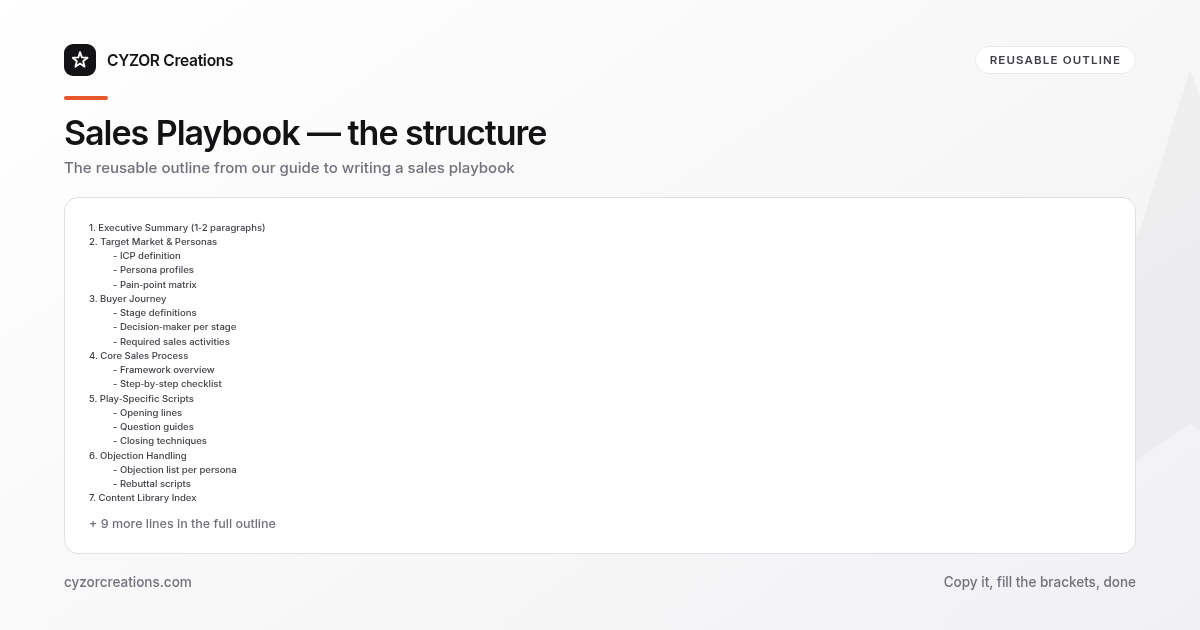
A Simple Structure to Follow
1. Executive Summary (1‑2 paragraphs)
2. Target Market & Personas
 - ICP definition
 - Persona profiles
 - Pain‑point matrix
3. Buyer Journey
 - Stage definitions
 - Decision‑maker per stage
 - Required sales activities
4. Core Sales Process
 - Framework overview
 - Step‑by‑step checklist
5. Play‑Specific Scripts
 - Opening lines
 - Question guides
 - Closing techniques
6. Objection Handling
 - Objection list per persona
 - Rebuttal scripts
7. Content Library Index
 - Asset name | Type | When to use | Version | Owner
8. Metrics & Review Cadence
 - KPI definitions
 - Reporting schedule
 - Playbook maintenance plan
9. Training & Enablement
 - Onboarding flow
 - Certification quiz
 - Ongoing coaching resources
Copy this outline into a shared document, then fill in each section with the specifics gathered in the Step‑by‑Step phase. The result is a modular playbook that can be expanded or trimmed without breaking the overall flow.
Common Mistakes to Avoid
- Overloading with “All the Slides.”
A playbook should point to the right slide, not embed every deck. Too many files make navigation impossible.
- Writing in “Corporate Speak.”
Scripts that sound like a press release confuse prospects. Keep language conversational and tied to the buyer’s language.
- Neglecting Updates.
A playbook that hasn’t been touched in six months quickly becomes irrelevant. Schedule the quarterly health check and stick to it.
- Mixing Strategy with Tactics.
High‑level market positioning belongs in a separate strategy doc. The playbook should focus on actionable steps, not long‑term vision.
- Assuming One Size Fits All.
If you force the same script on enterprise and SMB prospects, you’ll lose credibility. Tailor opening lines and objection handling to each persona.
A Short Example
> Persona: VP of Operations, mid‑market SaaS company (200–500 employees)
> Pain Point: “Our current workflow tools cause duplicate data entry, slowing down release cycles.”
> Opening Line: “I’ve spoken with several VPs of Operations who tell me that manual data entry is eating into their release time. Does that sound familiar?”
> Objection: “We already have a tool that integrates with our CRM.”
> Rebuttal: “Most integrations we see are one‑way, which still forces teams to copy data into a second system. Our solution provides a bi‑directional sync, eliminating the need for manual entry and cutting release prep time by up to 30%.”
Below the script, the playbook would list the supporting collateral:
| Asset | Type | When to Use | Version |
|---|---|---|---|
| “Duplicate Data” case study | After objection about existing tools | v3.1 | |
| ROI calculator | Spreadsheet | During pricing discussion | v2.0 |
Pro Tips
- Use a “Living Document” platform – Store the playbook in a version‑controlled space (e.g., a shared drive with a clear naming convention). This makes it easy to reference the latest version from any CRM note.
- Embed “quick‑look” cards – At the top of each section, add a 2‑line summary that tells a rep exactly what they’ll find: “Script for VP of Operations – see page 12.” This reduces scrolling time during calls.
- Use real call recordings – After each quarterly review, pull a high‑performing rep’s call, transcribe the opening, and replace the generic script with the actual phrasing that closed the deal.
- Tie every asset to a metric – For each piece of collateral, note the KPI it influences (e.g., “Case study → increases demo‑to‑close ratio by 12%”). When the metric moves, you have a concrete reason to keep or retire the asset.
- Create a “playbook champion” role – Assign one senior rep to own the quarterly health check. Their responsibility is to gather feedback, update scripts, and communicate changes to the rest of the team.
With a clear structure, disciplined updates, and a focus on actionable content, a sales playbook becomes the engine that drives consistent performance rather than a dusty reference file. Follow the steps, avoid the pitfalls, and treat the playbook as a living roadmap—your reps will close more deals, faster.