Why a Go‑to‑Market Strategy Matters (and What Trips People Up)
A go‑to‑market (GTM) strategy is the roadmap that turns a product or service from an idea into revenue. It forces you to answer three questions before you launch: who you’re selling to, how you’ll reach them, and what you’ll say to convince them. Skipping any of those steps usually ends in wasted spend, missed opportunities, or a launch that fizzles out before it gains traction.
Most founders and marketers stumble on two things: they treat the GTM plan as a marketing checklist instead of a cross‑functional blueprint, and they try to lock everything down before they have any market feedback. The result is a document that looks good on paper but collapses under real‑world pressure. The guide below walks you through a lean, repeatable process that keeps the plan grounded in data while still delivering a clear, actionable roadmap.
Step by Step
- Define the Target Segments
- Pull the latest sales data, support tickets, and any existing market research.
- Cluster customers by firmographic (size, industry, geography) and psychographic (pain points, buying triggers) attributes.
- Choose 1‑3 primary segments that together represent at least 30 % of your addressable market and where you have a defensible advantage.
- Validate the Value Proposition
- Draft a one‑sentence value statement for each segment (e.g., “For mid‑size manufacturers, our sensor reduces downtime by 20 %”).
- Run 5‑10 quick discovery interviews per segment. Ask: “What problem does this solve for you?” and “How much would a 20 % reduction in downtime be worth?”
- Refine the statement until the benefit and the monetary impact are both crystal clear.
- Map the Buying Journey
- Identify the decision‑maker, influencer, and gatekeeper roles in each segment.
- Plot the typical stages (Awareness → Consideration → Evaluation → Purchase → Adoption).
- For each stage, note the information the buyer needs and the channel they prefer (e.g., LinkedIn article for Awareness, case study for Evaluation).
- Select Channels and Tactics
- Match each journey stage to a channel that delivers the required content efficiently.
- Prioritize tactics that can be measured within the first 90 days (e.g., targeted email drip, webinar, direct‑mail sample).
- Assign a responsible owner and a budget line for each tactic; keep the total spend under 15 % of projected first‑year revenue.
- Build the Revenue Model
- Estimate conversion rates for each funnel stage based on historical data or industry benchmarks (e.g., 30 % Awareness → Consideration, 15 % Consideration → Evaluation).
- Multiply the segment size by the conversion chain to forecast qualified leads, deals, and revenue.
- Use the model to set realistic sales targets and to identify the minimum viable spend that still hits the revenue goal.
- Create the Execution Timeline
- Break the launch into 4‑week sprints: content creation, channel activation, lead nurturing, and performance review.
- Insert “gate” dates where you pause to validate assumptions (e.g., after the first webinar, check registration‑to‑meeting conversion).
- Document dependencies (e.g., sales enablement deck must be ready before the first outbound call) to avoid bottlenecks.
- Establish Measurement & Governance
- Choose 3‑5 leading indicators (e.g., Marketing Qualified Leads, pipeline velocity, win‑rate) and 2 lagging indicators (revenue, churn).
- Set up a weekly dashboard that pulls data from CRM, marketing automation, and finance.
- Assign a “GTM owner” who reviews the dashboard, flags deviations, and triggers corrective actions.
A Simple Structure to Follow
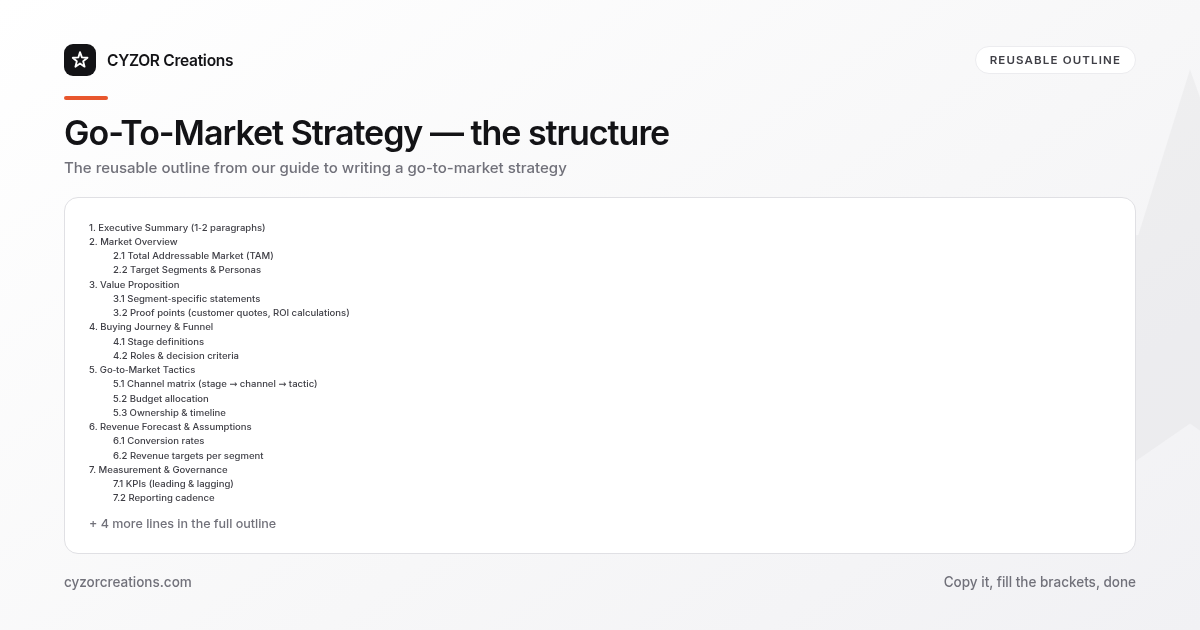
Below is a reusable outline you can copy into a Google Doc, Confluence page, or plain‑text file. Fill in each heading with the outputs from the steps above.
1. Executive Summary (1‑2 paragraphs)
2. Market Overview
   2.1 Total Addressable Market (TAM)
   2.2 Target Segments & Personas
3. Value Proposition
   3.1 Segment‑specific statements
   3.2 Proof points (customer quotes, ROI calculations)
4. Buying Journey & Funnel
   4.1 Stage definitions
   4.2 Roles & decision criteria
5. Go‑to‑Market Tactics
   5.1 Channel matrix (stage → channel → tactic)
   5.2 Budget allocation
   5.3 Ownership & timeline
6. Revenue Forecast & Assumptions
   6.1 Conversion rates
   6.2 Revenue targets per segment
7. Measurement & Governance
   7.1 KPIs (leading & lagging)
   7.2 Reporting cadence
   7.3 Escalation process
8. Risks & Mitigation
   8.1 Key assumptions
   8.2 Contingency plans
Copy, paste, and replace the placeholders. The structure forces you to keep the narrative tight while still providing enough detail for sales, product, and finance to act on it.
Common Mistakes to Avoid
- Skipping the validation interview – assuming the value proposition works without hearing “no” from real prospects.
- Over‑loading the plan with tactics – more channels than you can staff leads to half‑finished campaigns.
- Treating the GTM as a static document – failing to schedule regular assumption checks makes the plan stale.
- Relying on vanity metrics – clicks and impressions look good but don’t move the funnel forward.
- Neglecting the post‑sale handoff – sales may close a deal, but without a clear adoption plan the customer churns quickly.
A Short Example
> Segment: Regional health clinics (30–100 beds)
> Value Proposition: “Our tele‑triage platform cuts patient wait time by 25 % and reduces unnecessary ER referrals, saving each clinic an average of $120 k per year.”
> Buying Journey:
> - Awareness: LinkedIn carousel highlighting “average ER referral cost.”
> - Consideration: Webinar with a peer clinic that reduced referrals by 30 %.
> - Evaluation: ROI calculator embedded in a landing page; sales demo scheduled within 2 weeks.
> Tactics & Budget: $12 k total – $5 k for LinkedIn ads, $4 k for webinar production, $3 k for targeted direct mail.
> Revenue Model: 200 clinics in TAM → 10 % target segment → 20 % conversion to MQL → 15 % to closed‑won → $2.4 M ARR forecast for year 1.
The excerpt shows how each component of the template translates into a concrete plan for a single segment.
Pro Tips
- Start with the numbers you need to hit – reverse‑engineer the required pipeline from the revenue goal, then work backwards to leads and activities. This keeps every tactic tied to a measurable outcome.
- Use a “single‑source of truth” dashboard – pull data from CRM and marketing automation into one sheet; avoid maintaining separate spreadsheets that quickly diverge.
- Pilot one channel before scaling – run a 4‑week test on the channel you expect to be most effective, measure the conversion, then allocate additional budget only if the test meets its KPI.
- Document assumptions explicitly – write down the conversion rates, pricing, and market size you’re using. When reality deviates, you’ll know exactly which assumption to revisit.
- Involve sales early and often – they own the final handoff. Schedule a brief alignment call after each sprint to surface objections that may require a tweak to the value proposition or collateral.
With a disciplined step‑by‑step process, a reusable outline, and a habit of checking assumptions, you can turn a vague launch idea into a GTM plan that moves the needle on day one.