Why a 90‑day marketing plan matters – and why it trips people up
A 90‑day plan forces you to translate big‑picture goals into actions you can actually track. It’s short enough to stay agile, long enough to see measurable results. Most marketers stumble at the start because they either jump straight into tactics without a clear objective, or they draft a wish‑list of activities that never ties back to revenue or brand metrics. The result is a document that looks impressive on paper but never drives decisions.
The guide below walks you through a disciplined process, gives you a ready‑to‑use outline, and highlights the pitfalls that waste time and budget.
Step by Step
- Define the business outcome
- Ask yourself: What must happen in the next quarter for the business to consider this a success?
- Choose one primary KPI (e.g., $250 k new ARR, 15 % lift in qualified leads, 10 % market‑share gain) and two supporting metrics (conversion rate, churn, brand awareness). Write the KPI as a measurable statement: “Generate $250 k in new ARR from SMB SaaS customers.”
- Audit the current landscape
- Pull the last three months of channel performance (paid, owned, earned).
- Identify the top three assets that delivered the highest ROI and the three that underperformed.
- Conduct a quick competitor snapshot: note any new campaigns, pricing moves, or content themes that are resonating.
- Segment the target audience
- Break the market into 2‑4 personas based on firmographics, buying stage, and pain points.
- For each persona, list the top two decision‑maker roles and the primary channel they consume (e.g., “Product‑lead engineers – LinkedIn long‑form posts”).
- Set tactical objectives for each persona
- Translate the business KPI into persona‑level goals. Example: “Increase qualified leads from Product‑lead engineers by 20 % via LinkedIn webinars.”
- Assign a numeric target and a deadline (e.g., “Run three webinars, each attracting ≥150 registrants, by week 8”).
- Map tactics to channels and calendar
- For every tactical objective, pick a concrete activity (content piece, ad set, event) and a launch date.
- Use a simple Gantt view: week 1‑2 – content creation; week 3 – email blast; week 4 – paid promotion; week 5‑8 – nurture sequence.
- Allocate budget and resources
- Break the quarterly budget into channel buckets (e.g., 40 % paid media, 30 % content production, 20 % events, 10 % analytics).
- List owners for each activity (e.g., “Jane – copy, Tom – design, Alex – paid media”). Include any external vendor time if needed.
- Establish measurement and cadence
- Choose a reporting cadence (weekly dashboard, bi‑weekly review).
- Define the data source for each KPI (CRM, Google Analytics, ad platform).
- Set a “stop‑or‑pivot” rule: if a tactic’s cost‑per‑lead exceeds the budgeted threshold by week 4, reallocate spend.
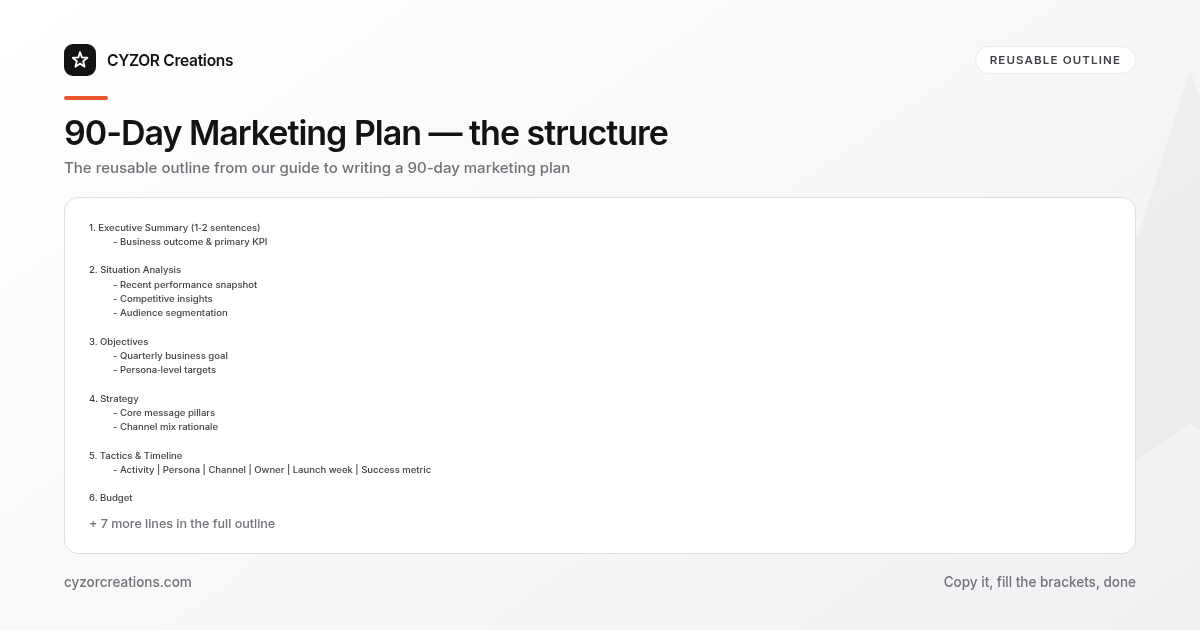
A Simple Structure to Follow
1. Executive Summary (1‑2 sentences)
 - Business outcome & primary KPI

2. Situation Analysis
 - Recent performance snapshot
 - Competitive insights
 - Audience segmentation

3. Objectives
 - Quarterly business goal
 - Persona‑level targets

4. Strategy
 - Core message pillars
 - Channel mix rationale

5. Tactics & Timeline
 - Activity | Persona | Channel | Owner | Launch week | Success metric

6. Budget
 - Channel allocation (%)
 - Line‑item costs

7. Measurement
 - KPI dashboard layout
 - Review cadence
 - Decision thresholds
Copy the skeleton into a new document, replace the placeholders, and you have a reusable 90‑day plan in under an hour.
Common Mistakes to Avoid
- Setting vague objectives – “Increase brand awareness” without a numeric target makes tracking impossible.
- Over‑loading the calendar – Packing every week with a new campaign leads to execution fatigue and poor data.
- Ignoring the sales funnel – Planning only top‑of‑funnel tactics leaves the middle and bottom stages unsupported.
- Failing to assign owners – A task without a named responsible person drifts into “someone will do it.”
- Skipping the stop‑or‑pivot rule – Without a clear performance trigger you keep spending on under‑performing assets.
A Short Example
> Executive Summary – Generate $250 k in new ARR from SMB SaaS customers by the end of Q3.
> Situation Analysis – Last quarter: paid LinkedIn ads delivered 2.3 % conversion at $45 CPL; webinars generated 180 qualified leads but a 30 % no‑show rate. Competitor X launched a “Free Trial Week” that lifted their demo requests by 12 %.
> Objectives – Increase qualified leads from Product‑lead engineers by 20 % (target: 216 leads).
> Strategy – Position our API as “plug‑and‑play” for rapid prototyping; double‑down on LinkedIn and developer forums.
> Tactics & Timeline
> | Activity | Persona | Channel | Owner | Launch week | Success metric |
> |------------------------|-----------------------|-----------|-------|------------|----------------|
> | Webinar series (3) | Product‑lead engineers| LinkedIn | Jane | 3‑5 | ≥150 registrants each |
> | Sponsored posts | Product‑lead engineers| LinkedIn | Tom | 2‑8 | CPL ≤ $40 |
> | Demo‑request landing page | All SMB prospects | Paid search| Alex | 4‑6 | Conversion ≥ 5 % |
> Budget – $120 k total: Paid media $48 k, Content production $36 k, Events $24 k, Analytics $12 k.
> Measurement – Weekly dashboard tracks CPL, webinar registration, demo requests; bi‑weekly review triggers reallocation if CPL > $45 for two consecutive weeks.
Pro Tips
- Batch content creation – Write all webinar scripts and supporting blog posts in a single two‑day sprint. This reduces context switching and guarantees consistent messaging.
- Use a “single source of truth” spreadsheet – Keep the calendar, budget, and owners on one tab; link KPI cells to a live dashboard to avoid version drift.
- Pre‑qualify leads with a short gate – Adding a single qualifying question to the webinar registration form can lift conversion from registrant to qualified lead without hurting sign-up rates.
- Reuse existing assets – Repurpose a high‑performing case study into a carousel ad, a LinkedIn post, and a downloadable PDF. This stretches budget and reinforces the core message.
- Schedule a mid‑quarter “pulse check” – At week 6, run a quick SWOT on the tactics that are on track versus those lagging. Use the findings to adjust spend before the final two weeks, when every dollar counts.
Follow the steps, stick to the template, and treat the 90‑day plan as a living document—not a static report. The discipline of defining a single business outcome, aligning every tactic to that outcome, and measuring weekly will turn a vague ambition into a measurable, repeatable engine for growth.