Why a Good Reference Letter Matters – and What Trips People Up
A reference letter is often the decisive piece in a hiring, scholarship, or graduate‑school file. It gives the decision‑maker a glimpse of the candidate’s character, work habits, and potential that a résumé alone cannot convey. Most writers stumble over three things: finding the right tone, choosing concrete evidence, and staying within the expected length. The result is either a vague endorsement that feels generic, or a rambling narrative that loses the reader’s attention.
Step by Step
- Gather the essentials – Ask the candidate for a copy of their résumé, a brief list of achievements they want highlighted, and the exact purpose of the letter (job title, program name, deadline). If possible, get the posting or criteria; it tells you which qualities to emphasize.
- Clarify your relationship – Write a one‑sentence description of how you know the candidate (e.g., “I supervised Alex for three years as a senior software engineer”). This anchors the credibility of your comments.
- Pick two to three standout examples – Choose achievements that are quantifiable or vividly described. For a sales role, a 30 % revenue increase is stronger than “great at meeting targets.” For a research program, a published paper or a successful experiment carries weight.
- Draft the core paragraph – Start with the relationship sentence, then follow with a concise statement of the candidate’s primary strength, and finally illustrate that strength with the examples you selected. Keep each sentence under 25 words.
- Tailor the language to the audience – If the letter is for an academic program, use terms like “rigorous,” “methodical,” and “scholarly curiosity.” For a corporate role, focus on “results‑driven,” “team leadership,” and “client satisfaction.”
- Add a closing endorsement – Summarize the candidate’s fit in one sentence, then state your unequivocal recommendation (e.g., “I recommend Maya without reservation”). Include your contact information for follow‑up.
- Edit for length and tone – Aim for 300–400 words total. Remove any filler (“I am pleased to write”) and replace vague adjectives with specific descriptors (“reliable” → “consistently delivered projects two weeks ahead of schedule”).
A Simple Structure to Follow
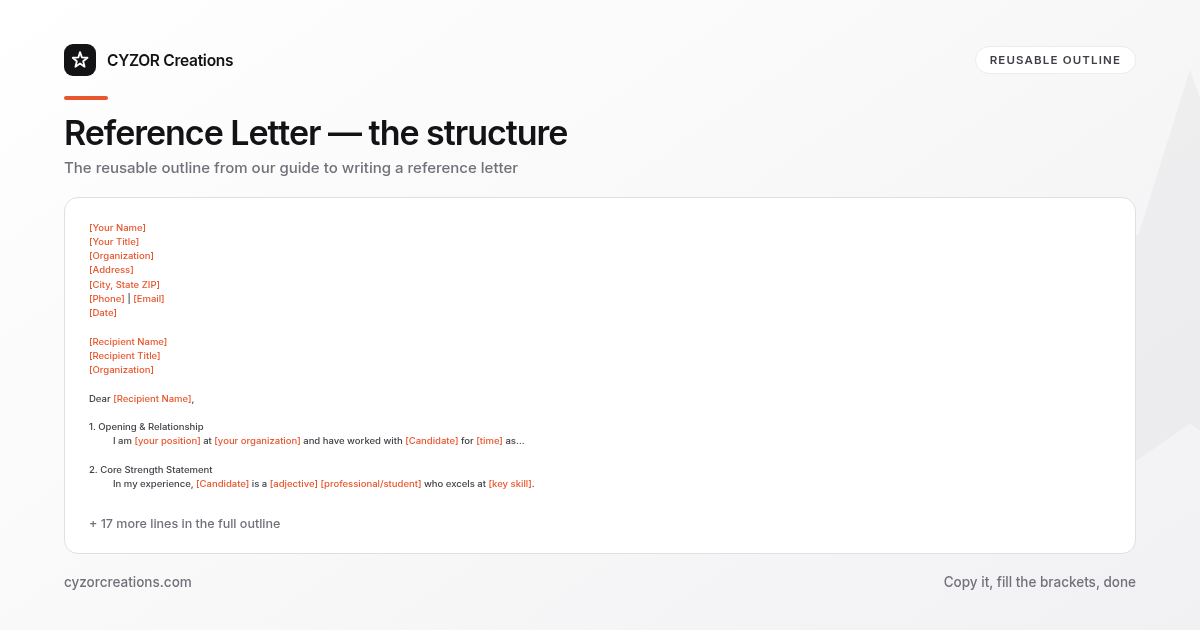
[Your Name]
[Your Title]
[Organization]
[Address]
[City, State ZIP]
[Phone] | [Email]
[Date]

[Recipient Name]
[Recipient Title]
[Organization]

Dear [Recipient Name],

1. **Opening & Relationship**
 I am [your position] at [your organization] and have worked with [Candidate] for [time] as [role/interaction].

2. **Core Strength Statement**
 In my experience, [Candidate] is a [adjective] [professional/student] who excels at [key skill].

3. **Evidence – Example #1**
 • Brief description of achievement, including numbers or outcomes.
 • Why this matters for the target position/program.

4. **Evidence – Example #2 (optional)**
 • Another concrete illustration that showcases a different but complementary skill.

5. **Fit for the Target**
 Given the demands of [position/program], I am confident that [Candidate] will [specific contribution].

6. **Closing Endorsement**
 I recommend [Candidate] without reservation. Please feel free to contact me at [phone/email] for any further information.

Sincerely,

[Signature]
[Typed Name]
Fill the placeholders once and reuse the skeleton for future letters. The bullet points keep the body scannable, and the template guarantees you never omit a crucial element.
Common Mistakes to Avoid
- Vague praise – “She is a hard worker” tells nothing about performance. Replace with measurable results.
- Overly personal anecdotes – Stories about a candidate’s hobbies or family life are irrelevant unless directly tied to the role.
- Lengthy introductions – Starting with “I am honored to write this letter” wastes space; jump straight to the relationship sentence.
- Repeating the résumé – Do not list every job duty; focus on achievements the candidate cannot convey elsewhere.
- Neglecting the deadline – Sending a letter after the stated date can jeopardize the candidate’s application; plan to finish at least two days early.
A Short Example
> To the Admissions Committee,
> I have supervised Priya Patel for the past 18 months as a research associate in the Materials Science Lab at GreenTech University. Priya is an exceptionally analytical scientist who consistently transforms ambiguous problems into testable hypotheses. In her first project, she designed a low‑cost polymer coating that reduced corrosion rates by 42 % compared with the standard benchmark—a result that earned the department’s Innovation Award. Her ability to communicate complex data clearly was evident when she presented the findings at the International Materials Conference, where she fielded questions from senior industry leaders. Given the rigorous experimental focus of your Ph.D. program, I am confident Priya will contribute both technical expertise and collaborative spirit. I recommend her without reservation and am happy to discuss her qualifications further at (555) 123‑4567.
> Sincerely,
> Dr. Luis Moreno, Ph.D.
The excerpt follows the template, stays under 200 words, and showcases quantifiable impact.
Pro Tips
- Ask for a “highlight sheet.” A one‑page list from the candidate of the achievements they most want emphasized saves you time hunting for details.
- Mirror the job description language. If the posting lists “project management” and “cross‑functional communication,” weave those exact phrases into your letter; it signals alignment to the reviewer.
- Use active voice and strong verbs. “Led a team of five” beats “was responsible for leading.”
- Proofread aloud. Hearing each sentence forces you to cut filler and catch awkward phrasing.
- Store a master copy. Keep a dated, editable version of your template; you can pull it quickly for future requests and maintain consistency across letters.