Why a Pitch‑deck Package Matters (and What Trips People Up)
A pitch‑deck package is the single document—or set of slides—that investors, partners, or internal stakeholders use to decide whether they want to fund or support your venture. It condenses months of research, product development, and market validation into a narrative that can be skimmed in five minutes but remembered weeks later.
Most founders stumble on three things:
- Scope creep – trying to cram every detail into the deck, which dilutes the core message.
- Visual clutter – using dense text or low‑resolution graphics that force the reader to squint.
- Narrative gaps – leaving out the “why now” or the clear path to revenue, so the story feels unfinished.
A well‑crafted package avoids these pitfalls by focusing on a tight storyline, clean visuals, and a logical flow that leads the reader to a single ask.
Step by Step
- Define the Core Ask
Write a one‑sentence statement of what you need (e.g., “$500 k for a 12‑month runway to launch our SaaS platform”). Everything in the deck should support this ask.
- Gather the Hard Data
Pull the latest metrics: monthly recurring revenue (MRR), churn, customer acquisition cost (CAC), lifetime value (LTV), and any traction milestones. Keep the source date next to each number (e.g., “MRR $45 k – March 2026”).
- Sketch a Storyboard
On a blank sheet, list the 10–12 slide titles you think you’ll need (you’ll refine this in the next section). Sketch a one‑sentence hook for each slide. This prevents you from adding filler later.
- Design the Visual Language
Choose a single typeface (e.g., Helvetica Neue), a primary color (e.g., #0066CC), and a secondary accent (e.g., #FF9900). Create a master slide with these settings so every subsequent slide inherits the same look.
- Write Concise Copy
Aim for 6–8 words per bullet, 30–40 characters per line. Replace “We aim to become the market leader” with “Targeting 30 % market share by 2028.” Use active verbs and avoid jargon.
- Iterate with Feedback
Share the draft with three people who are not involved in the project—ideally a potential customer, a finance professional, and a design‑savvy peer. Incorporate only feedback that strengthens the core ask or clarifies a data point.
- Finalize the Package
Export the deck as a PDF with embedded fonts, add a one‑page “Executive Summary” as the first page, and create a separate “Contact” slide with phone, email, and LinkedIn. Zip the PDF together with any supplemental data (e.g., a 2‑page financial model) and name the file CompanyName_PitchDeck_2026.pdf.
A Simple Structure to Follow
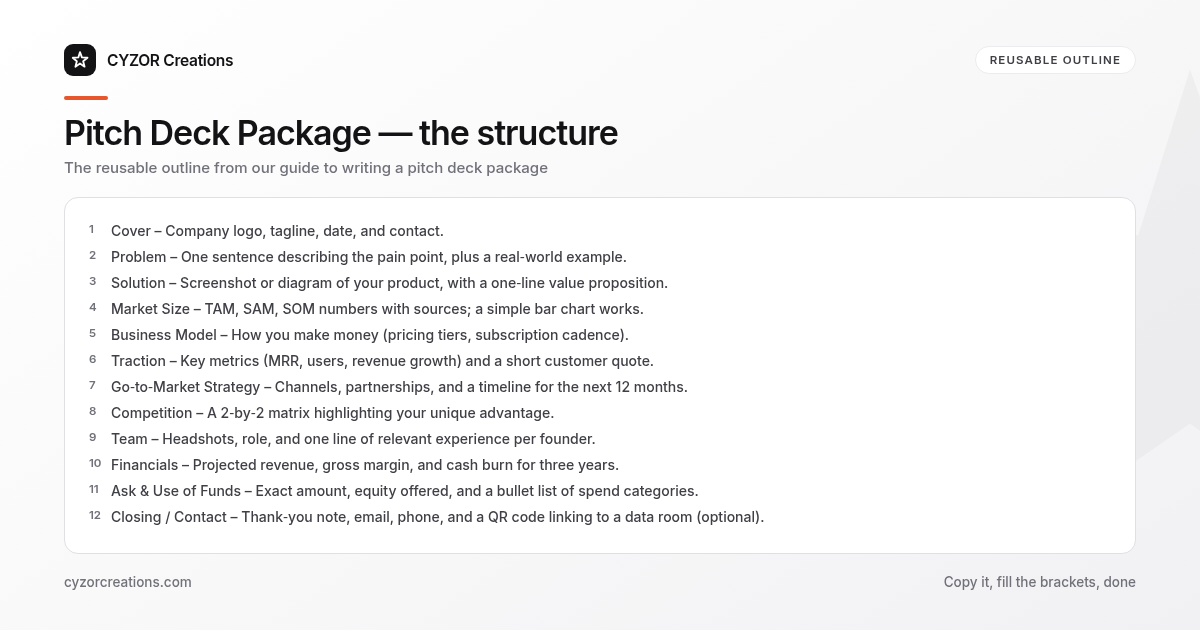
Below is a reusable outline that fits most early‑stage ventures. Each heading corresponds to a slide; the sub‑bullet shows the minimum content you need.
- Cover – Company logo, tagline, date, and contact.
- Problem – One sentence describing the pain point, plus a real‑world example.
- Solution – Screenshot or diagram of your product, with a one‑line value proposition.
- Market Size – TAM, SAM, SOM numbers with sources; a simple bar chart works.
- Business Model – How you make money (pricing tiers, subscription cadence).
- Traction – Key metrics (MRR, users, revenue growth) and a short customer quote.
- Go‑to‑Market Strategy – Channels, partnerships, and a timeline for the next 12 months.
- Competition – A 2‑by‑2 matrix highlighting your unique advantage.
- Team – Headshots, role, and one line of relevant experience per founder.
- Financials – Projected revenue, gross margin, and cash burn for three years.
- Ask & Use of Funds – Exact amount, equity offered, and a bullet list of spend categories.
- Closing / Contact – Thank‑you note, email, phone, and a QR code linking to a data room (optional).
Feel free to collapse “Problem” and “Solution” into a single slide if you need to stay under ten slides; the key is that each slide advances the narrative toward the ask.
Common Mistakes to Avoid
- Overloading Slides – More than three bullet points or a dense paragraph signals lack of focus.
- Vague Numbers – Saying “high growth” without a percentage or time frame leaves investors guessing.
- Inconsistent Branding – Switching fonts or colors mid‑deck breaks visual flow and looks unprofessional.
- Skipping the Competition – Pretending there is none raises red flags; a brief, honest comparison builds credibility.
- Leaving Out the Exit – Even early‑stage decks should hint at a realistic exit (acquisition, IPO) to show long‑term thinking.
A Short Example
> Slide 5 – Business Model
>
> Headline: “Subscription SaaS, $49/mo per seat”
>
> Bullet 1: “Enterprise tier: $199/mo, includes API access & dedicated support”
>
> Bullet 2: “Average contract length: 18 months, 95 % renewal rate”
>
> Visual: A two‑column table comparing the two plans, with a small icon next to each price point.
>
> Bottom note: “Projected ARR $2.1 M by Q4 2027 (30 % YoY growth)”
Notice the tight headline, concrete pricing, and a single data point that ties back to the financial forecast.
Pro Tips
- Lead with the Hook – Start the deck with a one‑sentence “pain‑point + solution” statement that can be read in under five seconds.
- Use Real Customer Voices – Insert a 10‑word quote from a paying user on the Traction slide; authenticity beats generic testimonials.
- Show, Don’t Tell – Replace a paragraph about “ease of use” with a screenshot of the UI and a caption like “5‑click workflow reduces onboarding time by 40 %.”
- Keep a Version Log – Add a tiny footer on each slide (e.g., “v3.2 – 04 Jul 2026”) so reviewers know they are looking at the latest numbers.
- Practice the 2‑Minute Pitch – Your deck should support a spoken pitch that can be delivered in 120 seconds; rehearse until the story flows without reading the slides.