Why a partnership proposal matters – and where writers stumble
A partnership proposal is the first formal conversation between two organizations. It tells the prospective partner what you bring to the table, how the collaboration will work, and why the joint effort is worth the time and resources of both sides. When done well, the proposal becomes a roadmap that short‑circuits endless email chains and gets decision‑makers to say “yes.”
Most people find the process hard because they try to cram everything into a single document, or they assume the partner already knows their value. The result is a vague, unfocused pitch that looks more like a sales brochure than a mutually beneficial plan. The key is to treat the proposal as a structured dialogue: start with the partner’s goals, then layer in your contribution, and finish with clear next steps.
Step by Step
- Research the partner’s priorities
- Scan recent press releases, annual reports, and social media feeds.
- Identify two to three strategic objectives that align with your own capabilities (e.g., market expansion, brand awareness, technology adoption).
- Record these objectives in a one‑page “partner brief” for quick reference.
- Define the joint value proposition
- Write a single sentence that states what you will do for the partner and what they will gain.
- Example: “We will co‑develop a mobile‑first loyalty app that drives a 15 % increase in repeat purchases for your retail brand.”
- Map out deliverables and timelines
- Break the project into phases (e.g., discovery, design, pilot, rollout).
- Assign realistic milestones and attach a rough budget range to each phase.
- Use a Gantt‑style table or a simple bullet list; clarity beats graphics.
- Draft the narrative
- Open with a brief acknowledgement of the partner’s recent achievements.
- Follow with the joint value proposition, then the phased plan, and close with a call to action (e.g., “Let’s schedule a 30‑minute call next week”).
- Keep each paragraph under 150 words; dense blocks lose attention.
- Add supporting evidence
- Include two case studies or metrics that prove you can deliver similar outcomes.
- Cite sources (e.g., “According to our 2023 client survey, 82 % of participants saw a lift in engagement within three months”).
- Polish for readability
- Use a sans‑serif font, 11‑pt size, and 1.15 line spacing.
- Insert headings for every major section; bold the value proposition.
- Run a spell‑check and ask a colleague to read aloud for flow.
- Send with a concise cover email
- One paragraph summarizing the proposal’s purpose.
- Attach the PDF and reference a specific next step (e.g., “I’ll follow up on Thursday at 10 am”).
A Simple Structure to Follow
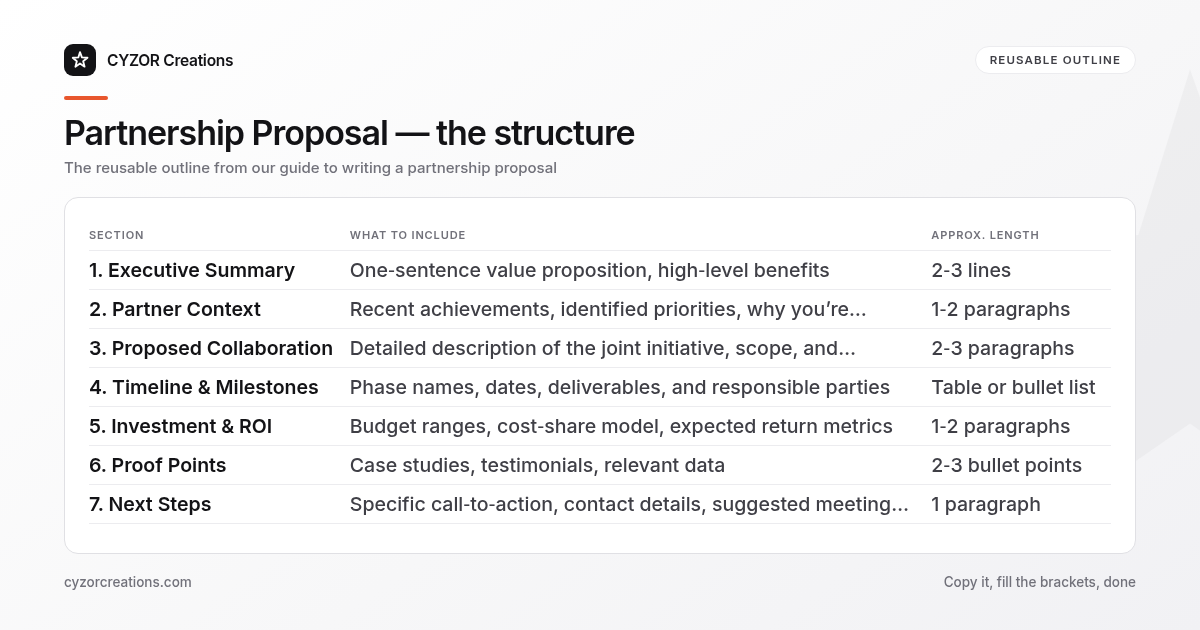
| Section | What to include | Approx. length |
|---|---|---|
| 1. Executive Summary | One‑sentence value proposition, high‑level benefits | 2‑3 lines |
| 2. Partner Context | Recent achievements, identified priorities, why you’re reaching out | 1‑2 paragraphs |
| 3. Proposed Collaboration | Detailed description of the joint initiative, scope, and responsibilities | 2‑3 paragraphs |
| 4. Timeline & Milestones | Phase names, dates, deliverables, and responsible parties | Table or bullet list |
| 5. Investment & ROI | Budget ranges, cost‑share model, expected return metrics | 1‑2 paragraphs |
| 6. Proof Points | Case studies, testimonials, relevant data | 2‑3 bullet points |
| 7. Next Steps | Specific call‑to‑action, contact details, suggested meeting date | 1 paragraph |
Copy this outline into a new document, replace the placeholders, and you have a reusable template that works for tech partnerships, co‑marketing deals, or nonprofit collaborations alike.
Common Mistakes to Avoid
- Assuming the partner knows your product – always start with their needs, not your features.
- Overloading the proposal with jargon – terms like “synergy” or “leveraging ecosystem” obscure meaning.
- Leaving the budget vague – “cost‑effective” without a range signals uncertainty.
- Skipping the proof points – decision‑makers need evidence before committing resources.
- Ending without a clear next step – a proposal that trails off leaves the conversation hanging.
A Short Example
> Executive Summary
> We will co‑create a limited‑edition “Eco‑Travel” video series that showcases your new line of sustainable luggage, driving a projected 12 % lift in online sales over six months.
>
> Partner Context
> Your recent “Green Horizons” campaign generated a 20 % increase in brand mentions on social media. Our audience research shows that 68 % of millennial travelers prioritize eco‑friendly gear when planning trips.
>
> Proposed Collaboration
> Phase 1 – Concept (Weeks 1‑2): Joint brainstorming session to define story arcs and key destinations.
> Phase 2 – Production (Weeks 3‑6): Our video team films three 2‑minute episodes, featuring your products in real‑world travel scenarios.
> Phase 3 – Distribution (Weeks 7‑10): Cross‑posted on your Instagram, YouTube, and our travel blog, with paid boost targeting eco‑conscious travelers.
>
> Investment & ROI
> Total production cost: $45,000 (shared 50/50). Expected incremental revenue: $150,000, based on a 12 % lift in conversion rates observed in a similar 2022 campaign.
>
> Next Steps
> Let’s lock in a 30‑minute call on Tuesday, 9 am PST, to finalize the creative brief and sign the partnership agreement.
Pro Tips
- Tailor the opening line to the partner’s latest news. A reference to a recent award or product launch shows you’re paying attention and makes the proposal feel personal.
- Quantify every claim. Instead of “increase engagement,” write “increase engagement by 18 % as measured by average watch time.” Numbers turn abstract benefits into concrete expectations.
- Use a “risk‑reversal” clause. Offer a performance‑based payment schedule (e.g., 30 % upfront, 70 % upon hitting the agreed KPI). This demonstrates confidence and reduces the partner’s perceived risk.
- Create a one‑page “cheat sheet” for executives. Busy leaders often skim; a single‑page summary with the value proposition, timeline, and ROI can be the deciding factor.
- Follow up within 48 hours with a brief recap email. Restate the key benefits, attach the PDF again, and propose a meeting slot. Prompt follow‑up keeps momentum and signals professionalism.