Why a Good LinkedIn Recommendation Matters (and What Trips People Up)
A LinkedIn recommendation is more than a polite note; it’s a public endorsement that can tip the scale when recruiters, clients, or collaborators evaluate a profile. Because it lives on the same page as work history and skills, a well‑crafted recommendation adds credibility and human context that a résumé alone cannot provide.
Most professionals stumble on two things: finding the right tone (too vague or overly salesy) and structuring the content so it feels personal yet concise. The result is often a bland paragraph that reads like a generic press release, which does little to help the person being recommended.
Step by Step
- Gather Context
Before you write, pull up the person’s LinkedIn profile, recent projects, and any performance reviews you have access to. Jot down three concrete outcomes you observed (e.g., “increased conversion rate by 12%,” “delivered a product two weeks ahead of schedule”).
- Identify the Audience
Ask yourself: Who will read this recommendation? Hiring managers, potential clients, or peers? Tailor the language to that audience—use business‑focused verbs for recruiters, and more collaborative phrasing for teammates.
- Choose a Core Message
Pick one overarching quality you want to highlight (leadership, technical expertise, reliability, etc.). This becomes the anchor that ties the rest of the paragraph together.
- Draft the Opening Sentence
Start with a clear statement of relationship and duration: “I worked with Maya for three years at Acme Corp, where she served as senior product manager.” This grounds the reader and establishes credibility.
- Add Two Specific Illustrations
Use the outcomes you noted in step 1 to illustrate the core message. Structure each illustration as action → result. Example: “She led a cross‑functional team to redesign the checkout flow, cutting cart abandonment by 18%.”
- Conclude with Impact and Recommendation
Summarize the lasting effect (“her data‑driven approach transformed our KPI tracking”) and end with an unequivocal endorsement (“I wholeheartedly recommend Maya for any senior product role”).
- Edit for Brevity and Tone
Read the draft aloud. Trim filler words, replace jargon with plain language, and ensure the tone matches the audience you identified. Aim for 150‑200 words total.
A Simple Structure to Follow
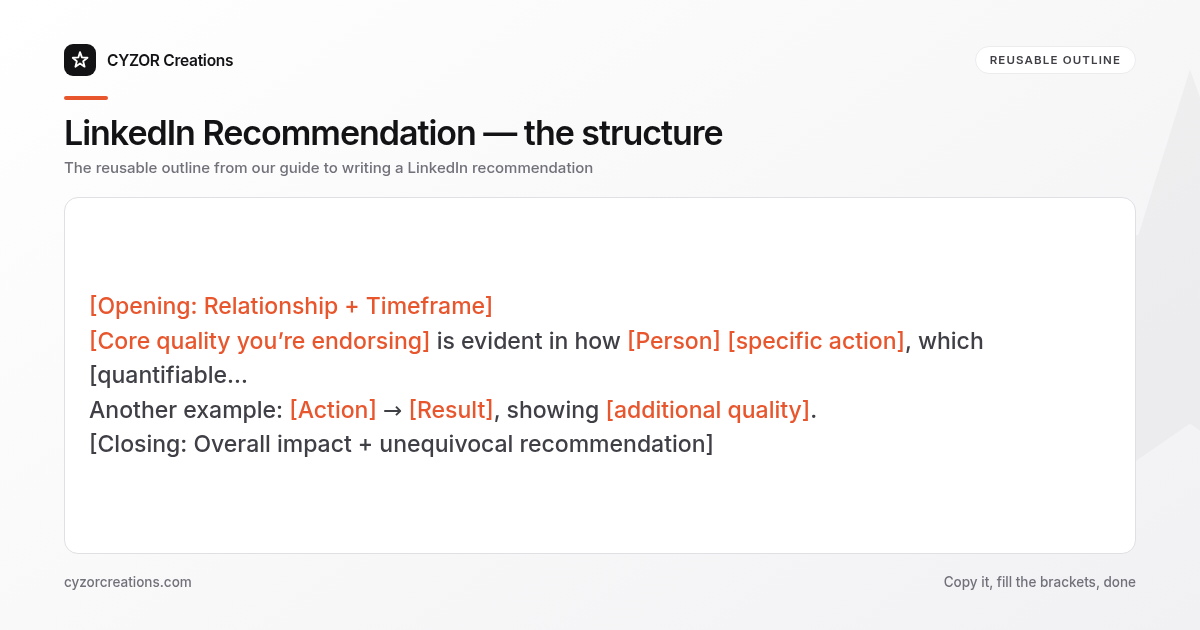
[Opening: Relationship + Timeframe]
[Core quality you’re endorsing] is evident in how [Person] [specific action], which [quantifiable result].
Another example: [Action] → [Result], showing [additional quality].
[Closing: Overall impact + unequivocal recommendation]
Template Example
> I supervised Jordan for two years at TechSolutions, where he was a software engineer.
> Jordan’s problem‑solving skills shone when he refactored the legacy billing API, reducing response time from 1.8 seconds to 0.6 seconds.
> He also introduced automated integration tests that caught 95 % of regressions before release, saving the team an estimated 30 hours of manual debugging each sprint.
> Jordan’s blend of technical depth and proactive ownership makes him an asset to any development team; I recommend him without reservation.
Feel free to copy‑paste the skeleton and replace the placeholders with your own details.
Common Mistakes to Avoid
- Vague adjectives without evidence – “great team player” tells nothing unless you back it up with a concrete story.
- Over‑inflated superlatives – Phrases like “the best ever” raise skepticism; stick to observable outcomes.
- Lengthy paragraphs – More than three sentences often dilute impact; keep it tight.
- Using first‑person plural (“we”) – The recommendation should focus on the individual, not the team.
- Neglecting proofreading – Typos or grammatical errors undermine credibility; a quick read‑through is essential.
A Short Example
> I collaborated with Lena for 18 months at BrightMedia, where she was the lead UX designer.
> Lena transformed our mobile onboarding flow, cutting the drop‑off rate from 42 % to 21 % within a single quarter.
> She also instituted a design‑system library that reduced UI inconsistencies across the product suite by 80 %.
> Lena’s ability to blend user empathy with data‑driven decisions consistently elevated our product quality. I highly recommend her for any senior design role.
Pro Tips
- Use Numbers Sparingly – Quantitative results are powerful, but only include them when they’re accurate and meaningful. A single well‑chosen metric beats a list of vague percentages.
- Mirror the Recipient’s Voice – If the person you’re recommending uses a particular phrasing (“customer‑centric,” “agile mindset”), echo that language to reinforce authenticity.
- Ask for a Quick Review – Send the draft to the person you’re recommending; a brief check ensures you haven’t mischaracterized any project details.
- Add a Personal Touch – A short sentence about a memorable interaction (e.g., “I’ll never forget the night she stayed late to debug the release”) humanizes the recommendation.
- Save the Template – Keep a copy of the structure in a note‑taking app. When a new request arrives, you’ll only need to swap out the specifics, making the process faster and more consistent.