Why a Persona Pack Matters – and What Trips People Up
A well‑crafted customer persona pack is the single source of truth that lets marketers, designers, and product teams speak the same language about the people they’re building for. When the pack is clear, onboarding new hires, aligning cross‑functional roadmaps, and testing hypotheses become almost automatic.
Most teams stumble at two points:
- Scope creep – they try to capture every possible demographic detail, ending up with a bloated document that no one reads.
- Lack of context – they list facts (age, income) without the “why” that drives behavior, so the personas feel like static data sheets instead of living characters.
The guide below shows how to avoid those pitfalls and produce a lean, actionable persona pack that fits into any sprint or quarterly planning cycle.
Step by Step
- Define the business objective
- Write a one‑sentence goal that the personas will support (e.g., “Increase conversion on the premium subscription page”).
- Keep the objective visible throughout the process; every data point should tie back to it.
- Gather raw data
- Pull quantitative signals from analytics (e.g., top‑10 user segments by revenue, churn rate).
- Conduct 3–5 qualitative interviews per segment; ask about daily routines, pain points, and decision triggers.
- Capture quotes verbatim; they become the “voice” of the persona later.
- Cluster users into 2–4 archetypes
- Use a simple affinity diagram: write each interview insight on a sticky note, then group similar themes together.
- Validate clusters with a quick internal poll: does each group feel distinct and actionable?
- Draft the persona narrative
- For each archetype, write a 150‑word story that includes:
- Name & tagline (e.g., “Mia, the time‑pressed freelancer”)
- Demographics (age range, location, job title) – keep it to three data points.
- Primary goal (what they want to achieve)
- Key frustration (the obstacle that stops them)
- Decision criteria (price, speed, support, etc.)
- Add supporting artifacts
- Quote carousel: 2–3 real quotes that illustrate the goal and frustration.
- Journey snapshot: a mini‑timeline (awareness → consideration → purchase) with the persona’s emotional state at each stage.
- KPIs to watch – list the metrics that will indicate whether you’re meeting this persona’s goal (e.g., “average time to checkout”).
- Review and iterate
- Share the draft with a cross‑functional group (sales, support, engineering).
- Collect feedback on clarity and relevance; revise within 48 hours.
- Lock the version and store it in a shared folder with a clear naming convention (e.g.,
PersonaPack_Q3_2026.pdf).
- Deploy and maintain
- Introduce the pack at the next sprint planning meeting; assign a “persona champion” to keep it up‑to‑date.
- Schedule a quarterly audit: compare current analytics to the persona’s KPIs and adjust the narrative if trends shift.
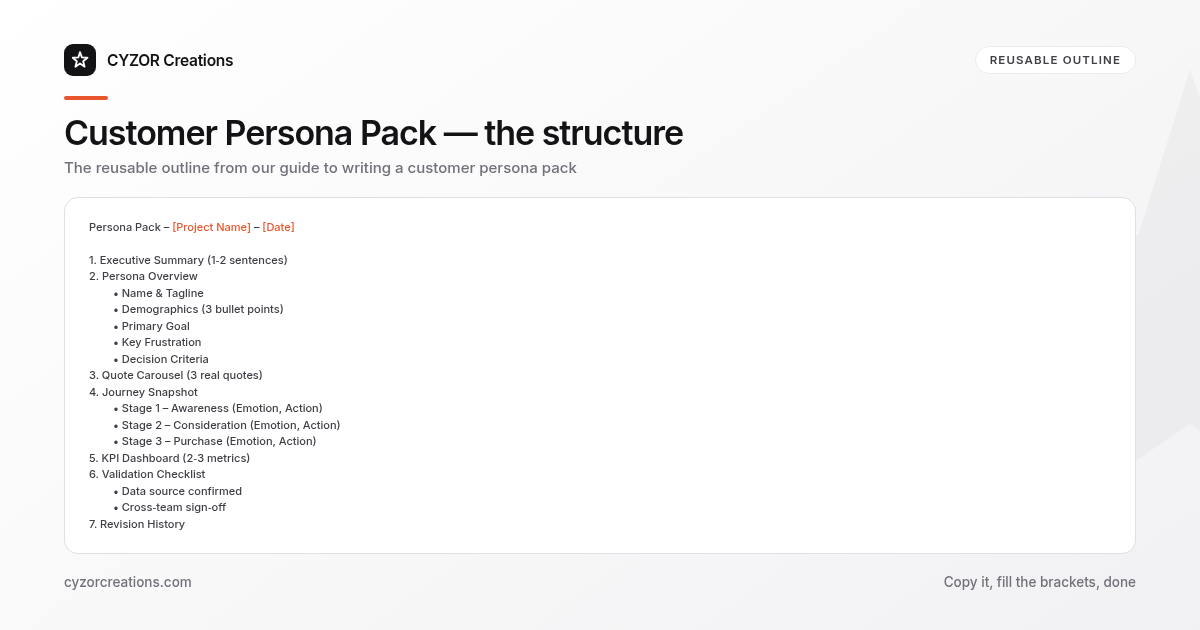
A Simple Structure to Follow
Persona Pack – [Project Name] – [Date]

1. Executive Summary (1‑2 sentences)
2. Persona Overview
 • Name & Tagline
 • Demographics (3 bullet points)
 • Primary Goal
 • Key Frustration
 • Decision Criteria
3. Quote Carousel (3 real quotes)
4. Journey Snapshot
 • Stage 1 – Awareness (Emotion, Action)
 • Stage 2 – Consideration (Emotion, Action)
 • Stage 3 – Purchase (Emotion, Action)
5. KPI Dashboard (2‑3 metrics)
6. Validation Checklist
 • Data source confirmed
 • Cross‑team sign‑off
7. Revision History
Copy this outline into a new document for each project. The consistent format makes it easy for anyone to skim, locate the most relevant section, and apply the insights immediately.
Common Mistakes to Avoid
- Overloading with numbers – listing every statistic clutters the narrative; pick the top 2‑3 that directly influence the persona’s goal.
- Using generic names – “John Doe” or “Customer A” feels impersonal; choose a name that hints at the archetype (e.g., “Lena the budget‑conscious parent”).
- Neglecting emotional cues – a persona without feelings becomes a spreadsheet; always pair a goal with the corresponding frustration.
- Leaving the pack unversioned – without a revision log, teams can reference outdated assumptions.
- Skipping the validation step – assuming the draft is correct leads to misaligned campaigns; a quick cross‑functional review catches blind spots early.
A Short Example
Persona: Maya, the “Eco‑Aware Urban Commuter”

- Age: 28‑34, lives in a mid‑size city, works as a graphic designer.
- Primary Goal: Reduce her carbon footprint while maintaining a stylish wardrobe.
- Key Frustration: Most sustainable brands are either too pricey or lack trendy options.
- Decision Criteria: Material transparency, price per wear, brand story.

Quote Carousel:
1. “I love the idea of buying ethically, but if the price is double what I’m used to, I’ll look elsewhere.”
2. “I need to see the full lifecycle of a product before I trust it.”
3. “Style matters; I don’t want to sacrifice looks for sustainability.”

Journey Snapshot:
- Awareness: Browses Instagram sustainability hashtags; feels hopeful.
- Consideration: Visits brand sites, compares material certifications; feels skeptical.
- Purchase: Chooses a product with clear carbon‑offset data; feels satisfied.
This excerpt fits within the template, yet it tells a vivid story that a designer can translate into a UI flow and a marketer can turn into ad copy.
Pro Tips
- Anchor each persona to a single KPI – when the persona’s goal aligns with one measurable metric, success is easy to track.
- Use a “day in the life” vignette – a 3‑sentence scenario (morning commute, lunch break, evening decision) adds context without expanding the document.
- Use existing personas as a baseline – if you have a “legacy” persona, compare new data against it to spot shifts rather than starting from scratch.
- Keep the visual weight low – a single‑page PDF with minimal graphics loads faster for remote teams and encourages quick reference.
- Assign a “persona champion” – a person responsible for quarterly updates ensures the pack never becomes stale.
Follow this roadmap, and your persona pack will evolve from a static artifact into a living guide that drives product decisions, marketing experiments, and customer empathy across the organization.