Why a career‑change package matters – and where people stumble
Changing fields after a few years of experience feels like starting a new job without a résumé that speaks your language. Recruiters in a different industry look for evidence that your transferable skills are real, not just buzz‑words. A well‑crafted career‑change package (cover letter, résumé, and supporting narrative) does three things:
- Translates your past achievements into the language of the target role.
- Shows you understand the new sector’s priorities and culture.
- Closes the gap between what you’ve done and what the hiring manager needs right now.
Most candidates falter at the translation step. They either copy‑paste their old résumé verbatim, or they try to reinvent themselves with vague statements like “I’m a fast learner.” The result is a packet that looks either irrelevant or unsubstantiated, and it gets filtered out before a human even sees it.
Step by Step
- Define the target role and its core competencies
- Pull the top three job postings you’re eyeing. Highlight the required hard skills (e.g., SQL, project budgeting) and soft skills (e.g., stakeholder management).
- Write a one‑sentence “value proposition” that pairs one of your strongest past results with a key competency from the posting.
- Audit your existing work history
- List every project, responsibility, and metric from the past 5–7 years.
- For each item, note which of the target competencies it touches. If nothing matches, think laterally: a budget‑tracking spreadsheet can become “financial stewardship,” a cross‑functional meeting can become “collaboration across departments.”
- Rewrite achievements into the STAR‑plus format
- Situation – brief context (2‑3 words).
- Task – what you were asked to accomplish.
- Action – the specific steps you took, emphasizing tools or methods that matter to the new field.
- Result – quantifiable outcome (percentage, dollar amount, time saved).
- Plus – a short clause linking the result to the target competency (e.g., “demonstrating data‑driven decision making”).
- Craft a tailored cover letter
- First paragraph: hook that mentions a recent industry development and your enthusiasm to contribute.
- Second paragraph: two STAR‑plus bullets that prove you already solve the problems the hiring manager cares about.
- Third paragraph: a concise statement of how you’ll hit the first 90‑day goals you’ve identified (based on the job description).
- Close with a call to discuss how your “translation” skills can accelerate the team’s roadmap.
- Design a clean, industry‑appropriate résumé
- Use a single‑column layout with a professional sans‑serif font (10–11 pt).
- Header: name, phone, email, LinkedIn URL (optional).
- Summary (3 lines): your value proposition + two transferable competencies.
- Experience: each role limited to 4 bullet points, all STAR‑plus, ordered by relevance rather than chronology if that tells a clearer story.
- Skills: a short table of hard tools (e.g., Tableau, Agile) and soft attributes (e.g., negotiation, analytical thinking).
- Education & certifications: list only those that support the new field.
- Add a “Career‑Change Narrative” addendum (optional)
- One page, 300‑400 words, written in first person. Explain why you’re pivoting, what you’ve done to upskill (courses, volunteer projects), and how your past trajectory uniquely positions you to add immediate value.
- Proof, personalize, and send
- Run a spell‑check and then read each sentence aloud; awkward phrasing often hides in industry jargon.
- Replace generic salutations (“To whom it may concern”) with the hiring manager’s name.
- Save the files as “Firstname_Lastname_Resume.pdf” and “Firstname_Lastname_CoverLetter.pdf” to avoid version confusion.
- Email the recruiter with a brief 2‑sentence note that references the specific role and attaches the two PDFs.
A Simple Structure to Follow
Cover Letter
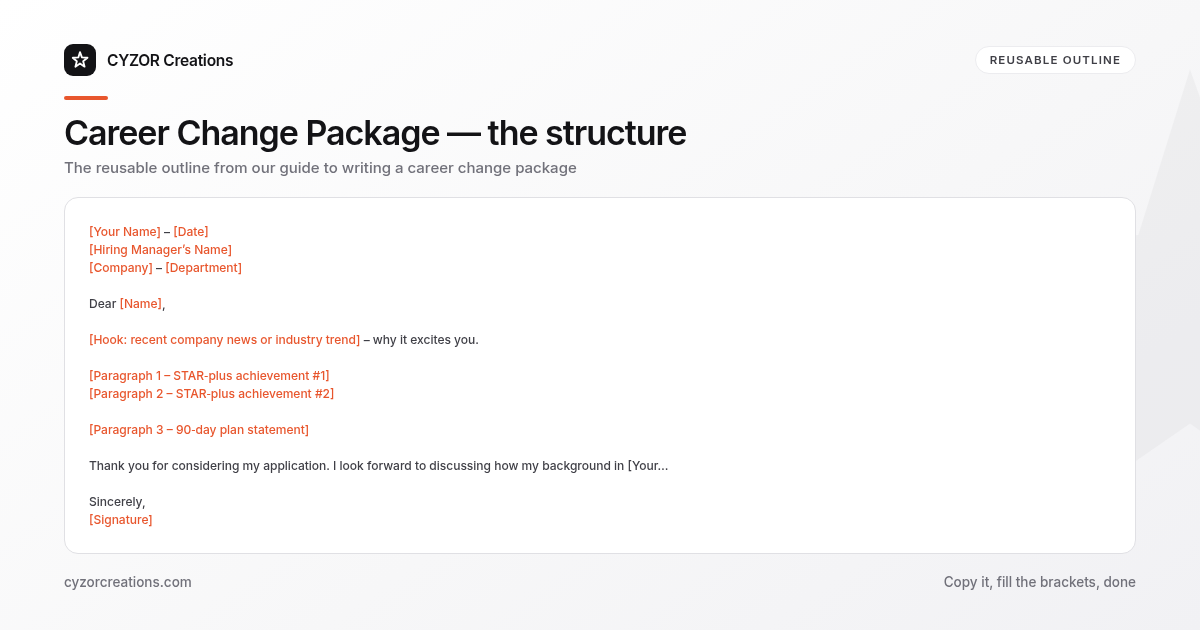
[Your Name] – [Date]
[Hiring Manager’s Name]
[Company] – [Department]

Dear [Name],

[Hook: recent company news or industry trend] – why it excites you.

[Paragraph 1 – STAR‑plus achievement #1]
[Paragraph 2 – STAR‑plus achievement #2]

[Paragraph 3 – 90‑day plan statement]

Thank you for considering my application. I look forward to discussing how my background in [Your Prior Field] can accelerate [Company]’s goals.

Sincerely,
[Signature]
Résumé
Firstname Lastname
Phone • Email • LinkedIn

SUMMARY
Dynamic professional with 6 years of data‑driven project delivery, skilled in X, Y, and Z. Proven ability to translate complex analytics into actionable strategy—ready to drive growth in [Target Industry].

EXPERIENCE
Company A – Role (Month Year – Present)
- Situation/Task: Led cross‑functional rollout of a new reporting platform.
- Action/Result: Built automated dashboards that cut reporting time by 40 % (saved $120 k annually), demonstrating rapid‑insight generation.
- Action/Result: Trained 30+ staff on data‑interpretation, boosting adoption rates to 95 %.

Company B – Role (Month Year – Month Year)
- Situation/Task: Managed a $2 M budget for product launches.
- Action/Result: Negotiated vendor contracts, reducing costs by 12 % while maintaining quality standards.

SKILLS
Data analysis: SQL, Python, Tableau
Project management: Agile, Scrum, Gantt
Communication: Stakeholder alignment, executive briefing

EDUCATION
B.S. Business Administration, University X (Year)
Career‑Change Narrative (optional)
After five years leading data‑intensive projects in the fintech sector, I realized my passion lies in shaping product strategy for consumer‑tech firms. To bridge the gap, I completed a certification in UX research, volunteered as a product mentor for a local startup incubator, and applied my analytical toolkit to redesign a mobile onboarding flow that increased conversion by 18 %. This blend of quantitative rigor and user‑centric thinking equips me to contribute immediately to [Target Company]’s product roadmap.Common Mistakes to Avoid
- Copy‑pasting old bullet points – they rarely address the new role’s keywords.
- Overloading the résumé with jargon – recruiters may not share your previous industry’s acronyms.
- Leaving the career‑change narrative vague – “I want a new challenge” sounds generic; explain the concrete steps you’ve taken.
- Submitting PDFs that aren’t searchable – scanned images prevent ATS parsing and frustrate recruiters.
- Neglecting a 90‑day plan – without it, hiring managers can’t picture your immediate impact.
A Short Example
> Cover Letter excerpt (first two paragraphs)
>
> Dear Ms. Patel,
>
> When XYZ Corp announced its expansion into AI‑enhanced analytics, I saw a direct line to the work I’ve been doing at Acme Financial, where I built a predictive churn model that reduced attrition by 22 % in twelve months.
>
> At Acme, I led a cross‑functional team of data engineers and marketers to integrate that model into our CRM, delivering weekly insights that informed $3 M of targeted campaigns. The result was a $540 k revenue uplift—exactly the kind of data‑driven growth you outlined for the Senior Analyst role.
Pro Tips
- Mirror the job description’s language – if the posting uses “stakeholder engagement,” use that exact phrase in your bullet points; ATS filters look for exact matches.
- Quantify every transferable skill – “managed a budget” becomes “oversaw a $1.4 M budget, delivering projects 5 % under target.” Numbers give credibility.
- Add a “Relevant Projects” section if your most recent role is unrelated; list freelance, volunteer, or coursework items that showcase the target competencies.
- Use a professional email address (firstname.lastname@domain.com) and a custom LinkedIn URL; consistency across documents signals attention to detail.
- Follow up within a week with a concise email referencing a specific point from the job posting; it demonstrates persistence without being pushy.
With a clear translation of past results, a focused narrative and a clean layout, your career-change package reads as a deliberate move rather than a gap. Good luck on the pivot.