Why a solid executive job package matters (and why it trips people up)
An executive job package is the single document—or set of documents—that lands on a hiring manager’s desk and decides whether you get the interview. It’s more than a résumé; it is a narrative that shows you understand the role, the organization’s strategic priorities, and how you’ll deliver impact from day one.
Most candidates stumble because they treat the package like a collection of unrelated artifacts. They paste a generic résumé, a vague cover letter, and a list of references together without a clear thread. The result is a pile of information that forces the reader to hunt for relevance, and busy executives will move on. A well‑crafted package, by contrast, tells a concise story, anticipates the decision‑maker’s questions, and positions you as the solution they didn’t know they needed.
Step by Step
- Research the organization’s top priorities
- Scan the latest annual report, press releases, and earnings calls. Note three strategic themes (e.g., digital transformation, market expansion, cost reduction).
- Write these themes on a sticky note; they will become the lens through which you frame every section of your package.
- Map your achievements to those themes
- For each theme, list two to three concrete results you delivered that align directly. Use the format Action → Result → Business Impact (e.g., “Led a cross‑functional team to launch a SaaS platform → 30 % increase in ARR → $12 M incremental revenue”).
- Quantify wherever possible; numbers are the quickest way to prove relevance.
- Draft a targeted executive summary (150‑200 words)
- Begin with a headline that captures the value you’ll bring (e.g., “Driving 20 % revenue growth through data‑enabled product strategy”).
- Follow with a two‑sentence snapshot of your most relevant experience, then close with a sentence that links your expertise to the company’s strategic theme.
- Tailor the résumé to the executive level
- Collapse early‑career roles into a single “Early Career” line; focus on senior‑level positions only.
- Use a reverse‑chronological layout, but add a “Key Impact” bullet under each role that directly references the strategic themes you identified.
- Create a concise “Strategic Fit” letter
- Unlike a generic cover letter, this is a 300‑word briefing addressed to the hiring leader. Structure it as: Why the role matters to you → How your track record solves the role’s biggest challenge → One concrete idea you would implement in the first 90 days.
- Keep the tone professional yet conversational; imagine you’re speaking to a board member.
- Assemble supporting evidence
- Include two optional items: (a) a one‑page “Results Dashboard” that visualizes your top metrics (e.g., revenue growth, cost savings) and (b) a brief “Stakeholder Testimonials” sheet with 2‑3 quotes from former CEOs or board chairs.
- Label each attachment clearly (e.g., “Appendix A – Results Dashboard”).
- Polish and package
- Convert all files to PDF, embed a clickable table of contents, and ensure the file size stays under 2 MB.
- Name the final file using the format
Lastname_Firstname_ExecutivePackage_Company.pdfto make it searchable for recruiters.
A Simple Structure to Follow
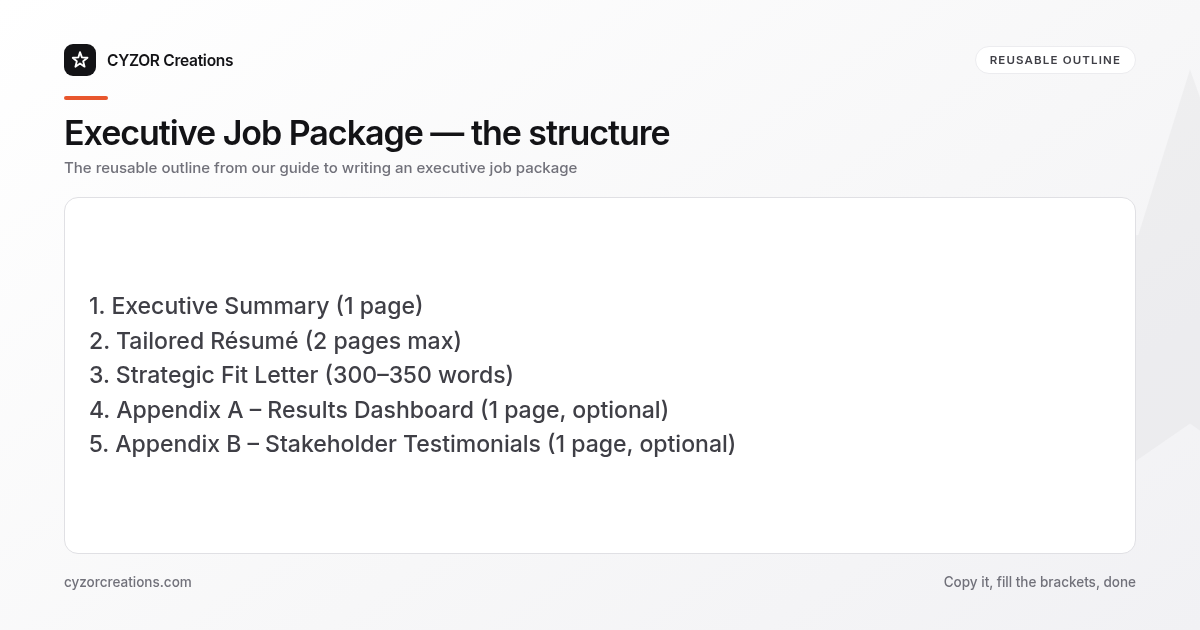
1. Executive Summary (1 page)
2. Tailored Résumé (2 pages max)
3. Strategic Fit Letter (300–350 words)
4. Appendix A – Results Dashboard (1 page, optional)
5. Appendix B – Stakeholder Testimonials (1 page, optional)
How to use the template
- Header: Place your name, phone, email, and LinkedIn URL centered at the top of every page.
- Page 1 – Executive Summary: Use the headline‑subheadline format, then a short paragraph that mirrors the company’s language.
- Page 2‑3 – Résumé: For each senior role, list Company, Title, Dates on one line, then three bullet points: Key Responsibility, Key Impact, Strategic Alignment.
- Page 4 – Strategic Fit Letter: Address the hiring leader by name, reference the specific job posting, and embed the “first‑90‑day idea” in a bolded sentence.
- Appendices: Keep visual elements simple—bar charts or sparklines for metrics, and a clean block‑quote format for testimonials.
Common Mistakes to Avoid
- Overloading with jargon – Using buzzwords without backing them up with data makes you sound vague.
- Repeating the same bullet across roles – Recruiters notice when you copy‑paste achievements; each bullet must be unique.
- Leaving gaps in employment – Unexplained gaps raise questions; add a brief note (e.g., “Sabbatical for professional development”) if needed.
- Submitting a one‑size‑fits‑all package – Tailor the executive summary and strategic fit letter for each target company; a generic version looks lazy.
- Neglecting visual hierarchy – Dense blocks of text without headings or whitespace force the reader to scroll; use bold headings and ample margins.
A Short Example
> Executive Summary
> Driving 20 % revenue growth through data‑enabled product strategy
> As VP of Product at XYZ Corp, I led a portfolio redesign that generated $15 M in incremental ARR within 18 months, while cutting time‑to‑market by 25 %. My experience aligns with ABC Inc.’s push for digital transformation, and I am eager to apply a data‑first roadmap that will capture untapped market segments.
> Strategic Fit Letter (excerpt)
> Dear Ms. Patel,
> The Chief Product Officer role at ABC Inc. is a natural next step for someone who has built revenue engines from the ground up. At XYZ Corp, I instituted a cross‑functional analytics hub that surfaced three high‑value product opportunities, delivering a 20 % uplift in quarterly revenue. Within my first 90 days at ABC, I would convene a “Revenue Insight Council” to surface similar opportunities, targeting a $10 M uplift by Q3 FY24.
Pro Tips
- Mirror the company’s language – Pull exact phrases from the job description (e.g., “customer‑centric innovation”) and embed them in your summary and letter. This signals cultural fit and improves keyword matching for ATS scans.
- Quantify impact with a consistent metric – If you choose “percentage revenue growth,” use it across all bullet points; consistency makes the narrative easier to digest.
- Bring a “first‑90‑day” idea – Executives love to see that you’ve thought beyond the interview. Keep the idea specific, feasible, and tied to a measurable outcome.
- Add a subtle branding element – A thin, muted line in your header that matches your personal logo (if you have one) adds polish without distracting.
- Run a “fresh‑eyes” test – Send the package to a trusted colleague who isn’t in your industry; ask them to summarize your value proposition in one sentence. If they can’t, tighten the narrative.
With a clear research foundation, a tightly aligned set of achievements, and a clean, executive‑level layout, your job package will stand out in the boardroom and move you from applicant to interview candidate.