Why a consultant page matters – and where writers stumble
A well‑crafted consultant page is often the first place a prospective client decides whether to keep reading or move on. It needs to convey expertise, show the kinds of problems you solve, and give a clear path to engagement. Most consultants struggle with two things: over‑selling (a laundry list of buzzwords that says nothing about real outcomes) and under‑selling (a vague résumé that fails to differentiate you from dozens of peers). The sweet spot is a concise narrative that blends credibility with a tangible value proposition.
Step by Step
- Define your target client – Write a one‑sentence persona: “Mid‑size SaaS founders who need to scale their go‑to‑market function without hiring a full‑time VP.” If you can’t name the audience, the page will be unfocused.
- Identify the core problem you solve – List the top three pain points you address (e.g., “stalled revenue growth, fragmented sales processes, and unclear pricing strategy”). Use the language your prospects use in LinkedIn posts or industry forums.
- Quantify your impact – Pull two or three concrete results from past engagements: “Reduced customer acquisition cost by 22 % in 90 days" or "Built a pricing model that added $1.2 M ARR within six months." Numbers give credibility faster than titles.
- Write a headline that combines client + result – Structure it as “I help [client] [desired outcome].” Example: “I help SaaS founders double their ARR in under a year.” Keep it under 12 words.
- Draft a brief “About Me” paragraph – Include three elements: (a) your relevant background (e.g., “10 years building sales teams at XYZ Corp”), (b) a single differentiator (e.g., “specialist in data‑driven pricing”), and (c) a personal touch (e.g., “I’m a former startup founder who knows the cash‑flow crunch”).
- Create a “How I work” section – Outline the engagement model in three steps: (1) discovery call, (2) diagnostic sprint, (3) implementation & hand‑off. Mention deliverables (e.g., “playbook, KPI dashboard, training workshop”) and typical timeline (e.g., “6‑8 weeks”).
- Add a clear call‑to‑action (CTA) – Use a button‑style phrase such as “Schedule a 15‑minute strategy call.” Below the CTA, place a short line that reduces friction: “No sales pitch, just a conversation about your growth hurdles.”
A Simple Structure to Follow
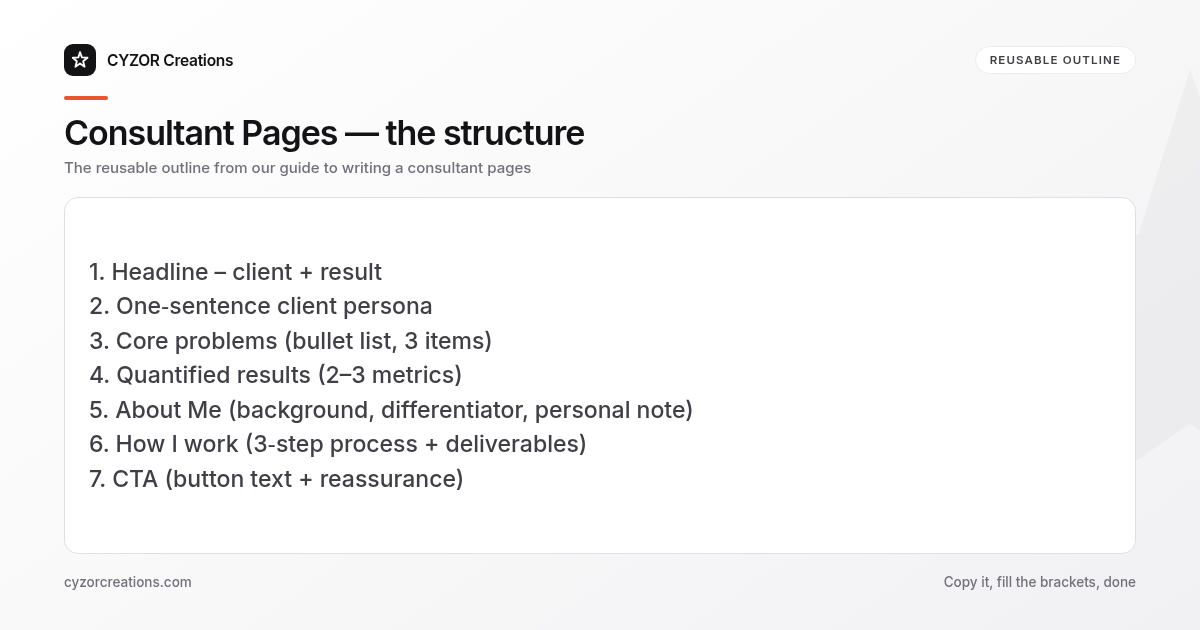
1. Headline – client + result
2. One‑sentence client persona
3. Core problems (bullet list, 3 items)
4. Quantified results (2–3 metrics)
5. About Me (background, differentiator, personal note)
6. How I work (3‑step process + deliverables)
7. CTA (button text + reassurance)
Copy‑paste this skeleton into a new page, then replace each placeholder with your own specifics. The layout keeps the page scannable: bold headings for each section, short paragraphs, and bullet points for easy reading.
Common Mistakes to Avoid
- Listing every skill – A laundry list dilutes focus; pick the three that matter most to your target client.
- Using vague adjectives – Words like “innovative” or “strategic” mean nothing without evidence.
- Leaving the CTA hidden – If the button is buried at the bottom of a long paragraph, visitors will miss it.
- Overloading with jargon – Acronyms and industry slang can alienate decision‑makers who are not specialists.
- Neglecting mobile readability – Long blocks of text look cramped on phones; break them into bite‑size chunks.
A Short Example
> I help SaaS founders double their ARR in under a year.
>
> You’re the founder of a $5 M SaaS company, and you’ve hit a plateau in new‑customer acquisition.
>
> What I solve
> - Stalled revenue growth despite strong product‑market fit
> - Disconnected sales and marketing teams
> - Pricing that leaves money on the table
>
> Results
> - 22 % reduction in CAC for a fintech client in 90 days
> - $1.2 M ARR added for a B2B SaaS startup within six months
>
> About me
> I spent a decade building sales orgs at XYZ Corp, where I led a team that grew revenue from $10 M to $45 M. My differentiator is a data‑first pricing framework that I’ve refined across 15 SaaS exits. When I’m not consulting, I coach early‑stage founders on cash‑flow management.
>
> How I work
> 1. Discovery call (30 min) – We surface the biggest growth blocker.
> 2. Diagnostic sprint (2 weeks) – I deliver a playbook and KPI dashboard.
> 3. Implementation (4 weeks) – I run workshops, embed processes, and hand over the reins.
>
> Ready to talk?
> [Schedule a 15‑minute strategy call] – No sales pitch, just a conversation about your growth hurdles.
Pro Tips
- Test headline variations – Swap “double ARR” for “increase revenue” and track click‑through on the CTA; the metric that yields the highest conversion becomes your default.
- Show a single client quote – A 15‑word testimonial that mentions a specific result (“We added $800 k ARR in three months”) adds social proof without clutter.
- Use a “sticky” CTA – Keep the schedule button visible as the reader scrolls; this removes the need to hunt for the action point.
- Refresh numbers quarterly – Replace outdated metrics with the latest wins to keep the page feeling current and trustworthy.
- Add a downloadable one‑pager – Offer a PDF that mirrors the page’s content; it gives prospects something tangible to share with their board.
The result is a higher likelihood that a visitor will move from curiosity to conversation.