Why a Good Business Proposal Matters – and What Trips People Up
A business proposal is the bridge between a problem you’ve identified and the resources you need to solve it. It convinces a client, a manager, or a funding board that your solution is realistic, profitable, and worth the investment. Most writers stumble on two things: structure (they either ramble or leave out critical sections) and tone (they sound either too casual or overly jargon‑laden). The result is a document that either confuses the reader or fails to inspire confidence. This guide cuts through the noise with a repeatable process, a ready‑made outline, and the pitfalls to watch for.
Step by Step
- Clarify the audience and objective
- Identify who will read the proposal (e.g., a procurement officer, a senior manager, a grant committee).
- Write a one‑sentence purpose statement: “To secure $150 k for a pilot of the automated inventory system.” Keep this statement visible as you draft; every paragraph should support it.
- Gather hard data
- Pull the latest financials, market research, and internal metrics that relate to the problem.
- Create a spreadsheet with three columns: Metric, Source, Relevance. This forces you to justify each number you plan to cite.
- Draft the problem narrative
- Start with a concrete fact (“Over the past 12 months, stock‑outs increased by 23 %”).
- Follow with the impact (“Each stock‑out costs the company an average of $4 200 in lost sales”).
- End with a concise need statement (“We need a solution that reduces stock‑outs by at least 50 % within six months”).
- Develop the solution description
- Outline the core components (technology, process change, staffing).
- Include a high‑level timeline (e.g., “Phase 1 – requirements gathering, 2 weeks”).
- Quantify benefits: cost savings, revenue lift, risk reduction. Use the data from step 2 to back each claim.
- Build the financial model
- List all cost categories (hardware, software licences, labor, training).
- Show a 3‑year projection: Year 1 (implementation), Year 2 (operational), Year 3 (optimization).
- Calculate ROI, payback period, and net present value (NPV) using a discount rate you know the organization accepts (often 8 %).
- Write the executive summary last
- Summarize the problem, solution, and financial upside in 150 words or fewer.
- Place it at the very front of the document so busy decision‑makers can skim it first.
- Polish and format
- Use a clean, sans‑serif font (11 pt) and 1‑inch margins.
- Insert a table of contents with clickable links if the file is PDF.
- Run a spell‑check, then read the proposal aloud; any sentence that trips you up is likely to trip the reader as well.
A Simple Structure to Follow
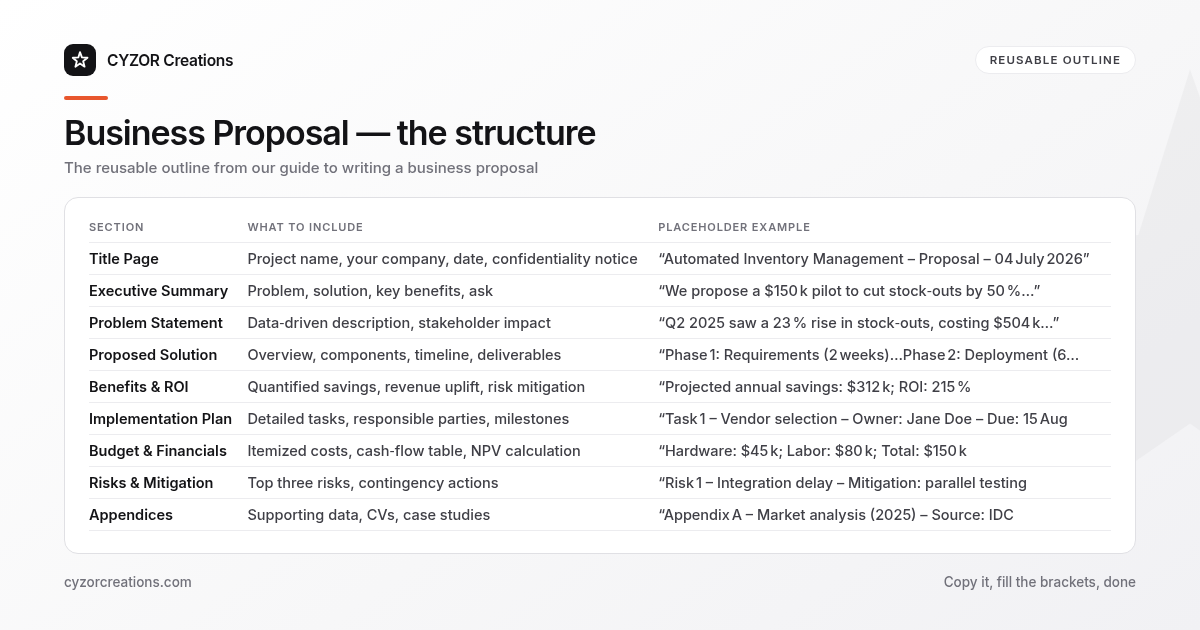
| Section | What to Include | Placeholder Example |
|---|---|---|
| Title Page | Project name, your company, date, confidentiality notice | “Automated Inventory Management – Proposal – 04 July 2026” |
| Executive Summary | Problem, solution, key benefits, ask | “We propose a $150 k pilot to cut stock‑outs by 50 %…” |
| Problem Statement | Data‑driven description, stakeholder impact | “Q2 2025 saw a 23 % rise in stock‑outs, costing $504 k…” |
| Proposed Solution | Overview, components, timeline, deliverables | “Phase 1: Requirements (2 weeks)…Phase 2: Deployment (6 weeks)… |
| Benefits & ROI | Quantified savings, revenue uplift, risk mitigation | “Projected annual savings: $312 k; ROI: 215 % |
| Implementation Plan | Detailed tasks, responsible parties, milestones | “Task 1 – Vendor selection – Owner: Jane Doe – Due: 15 Aug |
| Budget & Financials | Itemized costs, cash‑flow table, NPV calculation | “Hardware: $45 k; Labor: $80 k; Total: $150 k |
| Risks & Mitigation | Top three risks, contingency actions | “Risk 1 – Integration delay – Mitigation: parallel testing |
| Appendices | Supporting data, CVs, case studies | “Appendix A – Market analysis (2025) – Source: IDC |
Copy this table into a new document and replace the placeholders with your own numbers. The consistency of headings and tables makes it easy for reviewers to locate the information they need.
Common Mistakes to Avoid
- Skipping the executive summary – senior leaders often read only this section.
- Overloading with jargon – terms like “synergy” or “paradigm shift” obscure rather than clarify.
- Leaving out a clear ask – never assume the reader knows you want a contract; state the amount or decision you need.
- Using vague metrics – “significant cost reduction” is meaningless without a percentage or dollar figure.
- Neglecting risk analysis – a proposal that pretends everything will go perfectly looks naïve; acknowledge at least three realistic risks.
A Short Example
> Executive Summary
>
> Over the past year, our retail network experienced a 23 % increase in stock‑outs, translating to an estimated $504 k loss in revenue. We propose a six‑month pilot of an automated inventory management system, costing $150 k, that will reduce stock‑outs by at least 50 % and generate $312 k in annual savings. The pilot will be completed in three phases—requirements (2 weeks), implementation (6 weeks), and validation (4 weeks)—and will be overseen by the supply‑chain team with support from the IT department. Approval of the $150 k budget will enable us to begin the pilot on 1 September 2026 and deliver measurable results by March 2027.
This excerpt shows how the problem, solution, cost, timeline, and ask are compressed into a single paragraph that a busy executive can digest in under a minute.
Pro Tips
- Tailor the language to the decision‑maker’s vocabulary – if the CFO prefers “EBITDA impact,” use that phrase; if the operations manager talks about “throughput,” echo it.
- Include a one‑page “quick‑facts” sheet that lists the problem, solution, cost, ROI, and timeline side by side. It serves as a cheat‑sheet for reviewers during meetings.
- Anchor every claim to a source – footnote the market report, internal audit, or customer survey that backs each statistic. This builds credibility instantly.
- Use visual aids sparingly but effectively – a single bar chart comparing current vs. projected stock‑out rates can convey the benefit faster than a paragraph of numbers.
- Schedule a 15‑minute walk‑through with a non‑technical colleague before finalizing. If they can explain the proposal in plain language, you’ve likely succeeded in making it clear.
Follow the steps, reuse the template, and watch your proposals move from “nice to read” to “must approve.”