Why a solid workout plan matters – and where most people stumble
A workout plan is the bridge between vague intentions (“I want to get stronger”) and measurable results. Without a plan, you’re left guessing how many sets, what intensity, or when to rest, which leads to plateaus, injury, or wasted time. Most beginners falter at two points: they either over‑engineer the schedule (trying to hit every muscle every day) or they under‑specify it (just “go to the gym three times”). The sweet spot is a clear, realistic blueprint that tells you exactly what to do, when, and why.
Step by Step
- Define a concrete goal – Write it down in measurable terms. Example: “Add 10 kg to my squat in 12 weeks” or “Run a 5 km race under 25 min within 8 weeks.” A specific target dictates the training variables you’ll manipulate.
- Choose a training frequency – Decide how many sessions you can commit to each week and how they’ll be split. Typical splits:
- 3 days: full‑body A/B/C (e.g., push, pull, legs)
- 4 days: upper/lower alternating
- 5 days: push/pull/legs + cardio or mobility
- Select primary lifts and accessory work – For each session, pick 1–2 compound movements that address your goal, then add 2–3 accessory exercises. Compound example: squat, deadlift, bench press, overhead press, pull‑up. Accessory example: Bulgarian split squat, face pull, plank variations.
- Set the volume and intensity – Determine sets, reps, and load for each lift.
- Strength focus: 3–5 sets × 3–5 reps at 80–90 % 1RM.
- Hypertrophy focus: 3–4 sets × 8–12 reps at 65–75 % 1RM.
- Endurance focus: 2–3 sets × 15–20 reps at 50–60 % 1RM.
- Program progression – Decide how you’ll increase demand each week. Common methods:
- Linear: add 2.5 kg to the main lift every week.
- Double‑progression: add a rep until the top of the rep range, then increase weight.
- Wave: alternate heavy (5 reps) and light (8 reps) weeks.
- Schedule recovery and deload – Insert at least one full rest day per week and a planned deload (20–30 % reduction in volume) every 4–6 weeks.
- Track and review – Use a simple notebook or spreadsheet to log weight, reps, RPE (Rate of Perceived Exertion), and notes on how you felt. Review the data every 2 weeks and adjust the plan if progress stalls.
A Simple Structure to Follow
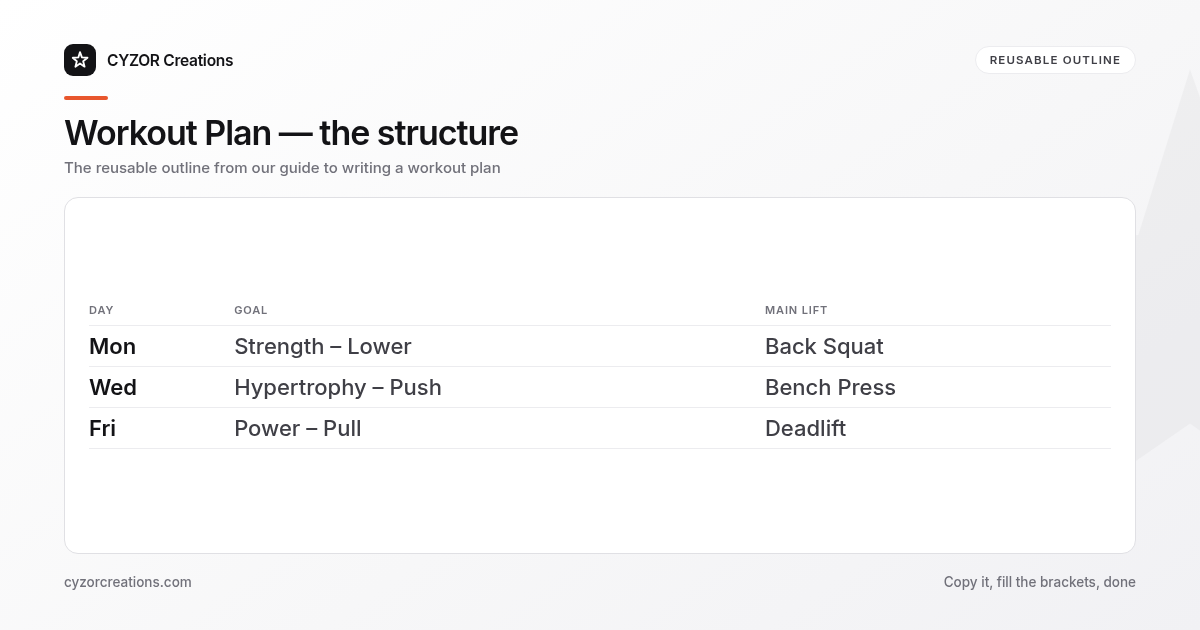
Below is a reusable outline you can copy into any notebook or spreadsheet. Fill in the blanks for each training day.
| Day | Goal | Main Lift | Sets × Reps × Load | Accessory 1 | Sets × Reps | Accessory 2 | Sets × Reps | Core/Conditioning | Notes |
|---|---|---|---|---|---|---|---|---|---|
| Mon | Strength – Lower | Back Squat | 4 × 5 × 80 % 1RM | Romanian Deadlift | 3 × 8 × 70 % | Walking Lunge | 2 × 12 each | Plank 3 × 60 s | Felt tight hips |
| Wed | Hypertrophy – Push | Bench Press | 3 × 10 × 70 % | Incline DB Press | 3 × 12 | Triceps Rope Push‑down | 3 × 15 | Side‑plank 2 × 45 s | Good pump |
| Fri | Power – Pull | Deadlift | 5 × 3 × 85 % | Pendlay Row | 4 × 6 | Face Pull | 3 × 15 | Farmer’s Walk 3 × 30 s | Grip slipping |
How to use the table
- Pick a day label (Mon, Wed, Fri) that matches your weekly schedule.
- Write the overarching goal for that session (strength, hypertrophy, power, endurance).
- Insert the main lift and its exact prescription.
- Add 2–3 accessories that complement the main lift and target weak points.
- Finish with a core or conditioning block that aligns with your overall objective.
- Leave a “Notes” column for subjective feedback—energy, soreness, technique cues—so you can spot trends.
Copy the table for each week, adjust the loads according to your progression rule, and you have a complete plan without reinventing the wheel each cycle.
Common Mistakes to Avoid
- Skipping warm‑up sets – Jumping straight to working weight raises injury risk.
- Changing more than one variable at a time – Altering load, reps, and rest simultaneously makes it impossible to know what drove the result.
- Neglecting progressive overload – Repeating the same weight week after week stalls adaptation.
- Overtraining the same muscle group – Hitting shoulders three days in a row leads to chronic soreness and diminished lifts.
- Ignoring mobility and flexibility – Tight hip flexors or thoracic spine limit squat depth and overhead press stability.
A Short Example
> Week 3 – Upper‑Body Hypertrophy (Tuesday)
> - Goal: Muscle growth in chest and triceps.
> - Main Lift: Bench Press – 3 × 10 × 70 % 1RM (70 kg).
> - Accessory 1: Incline Dumbbell Press – 3 × 12 × 22 kg each.
> - Accessory 2: Cable Flyes – 3 × 15 × 15 kg.
> - Accessory 3: Triceps Rope Push‑down – 3 × 15 × 30 kg.
> - Core: Hanging Leg Raise – 3 × 12.
> - Notes: Felt strong on the bench; elbows stayed tucked during flyes.
The example shows a complete session in under 60 minutes, with clear numbers that can be copied into the template table above.
Pro Tips
- Use RPE instead of strict percentages – Rate of Perceived Exertion (1–10) lets you adjust for daily fluctuations. An RPE = 8 for a 5‑rep set means you could have done two more reps; if you’re consistently at 9, bump the load next session.
- Batch your accessory work by movement pattern – Group all horizontal pulls (rows, face pulls) together, and all vertical pushes (overhead press, dips) together. This reduces neural fatigue and improves technique quality.
- Periodize every 4–6 weeks – Switch from a “strength” block (low reps, high load) to a “hypertrophy” block (moderate reps, moderate load) to keep muscles adapting and avoid mental burnout.
- Track tempo – Not just weight and reps, but the eccentric (lowering) and concentric (lifting) speed. A 3‑second eccentric on squats builds time under tension, which is a potent stimulus for growth.
- Plan a “skill day” – Dedicate one session per month to practice a technical lift (e.g., clean, snatch, pistol squat) with light weight and high reps. Skill acquisition improves overall performance and reduces injury risk.