Why a Social‑Media Strategy Matters (and What Trips People Up)
A social‑media strategy is the roadmap that turns scattered posts into measurable results. Without one, you’re guessing which platform to post on, how often, and what tone to use. The biggest pain points are — defining clear objectives, aligning content with audience behavior, and setting up a feedback loop that actually informs future decisions. The guide below walks you through a repeatable process, a ready‑to‑use template, and the pitfalls that waste time and budget.
Step by by Step
- Audit Your Current Presence
- List every account you own (brand, personal, regional).
- Pull the last 12 months of metrics: follower count, engagement rate, top‑performing posts.
- Note gaps (platforms you’re missing, inconsistent branding, outdated bios).
- Define Business‑Level Goals
- Choose 2–3 objectives that tie directly to revenue or brand health, e.g., “increase qualified leads by 15 % from LinkedIn” or “boost website traffic from Instagram by 20 %.”
- Translate each goal into a SMART KPI (Specific, Measurable, Achievable, Relevant, Time‑bound).
- Map Audience Personas to Platforms
- Create 3–5 personas with demographics, pain points, and preferred channels.
- Assign each persona a primary platform (e.g., “Tech‑savvy procurement manager → LinkedIn”) and a secondary one for amplification.
- Develop Content Pillars and Formats
- Identify 3–4 pillars that support your goals (e.g., “Thought leadership,” “Product tutorials,” “Customer stories”).
- For each pillar, list the formats you’ll use: short video, carousel, long‑form article, poll, etc.
- Pair pillars with publishing frequency (e.g., “Thought leadership – 2×/week”).
- Create a Publishing Calendar
- Use a spreadsheet or calendar view with columns: Date, Platform, Persona, Pillar, Format, Copy, CTA, Owner.
- Populate the next 4 weeks, leaving room for real‑time content (industry news, events).
- Assign a reviewer for each entry to enforce brand voice and compliance.
- Set Up Measurement & Reporting
- Choose a core set of metrics per platform (reach, engagement, click‑through, conversion).
- Build a weekly dashboard that pulls data automatically (or manually if you lack automation).
- Schedule a monthly review meeting to compare actuals against KPIs and decide on adjustments.
- Iterate and Optimize
- After each reporting cycle, identify the top‑performing and under‑performing posts.
- Conduct a quick “why?” analysis (creative, timing, audience mismatch).
- Update the calendar with new ideas, retire ineffective formats, and adjust frequency as needed.
A Simple Structure to Follow
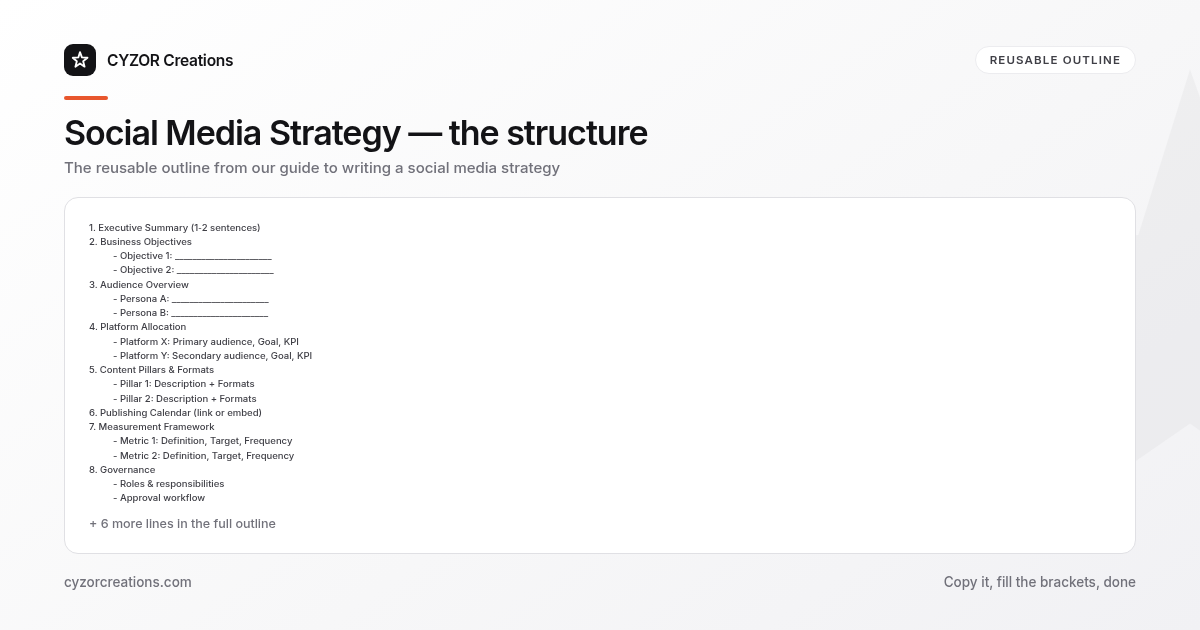
Below is a reusable outline you can copy into any document. Fill in the placeholders for each campaign or quarterly plan.
1. Executive Summary (1‑2 sentences)
2. Business Objectives
 - Objective 1: ______________________
 - Objective 2: ______________________
3. Audience Overview
 - Persona A: ______________________
 - Persona B: ______________________
4. Platform Allocation
 - Platform X: Primary audience, Goal, KPI
 - Platform Y: Secondary audience, Goal, KPI
5. Content Pillars & Formats
 - Pillar 1: Description + Formats
 - Pillar 2: Description + Formats
6. Publishing Calendar (link or embed)
7. Measurement Framework
 - Metric 1: Definition, Target, Frequency
 - Metric 2: Definition, Target, Frequency
8. Governance
 - Roles & responsibilities
 - Approval workflow
9. Budget & Resources
 - Paid media spend
 - Creative production costs
10. Risks & Mitigation
 - Risk A: Mitigation plan
 - Risk B: Mitigation plan
Keep the document under three pages; the goal is quick reference, not a novel.
Common Mistakes to Avoid
- Setting vanity goals – “more followers” without tying them to leads or sales.
- Posting the same content on every platform – each channel has distinct consumption habits.
- Neglecting a content calendar – ad‑hoc posting leads to inconsistent branding and missed opportunities.
- Skipping the audience persona step – you’ll waste impressions on the wrong people.
- Failing to review data – without a regular audit, you can’t tell what’s working.
A Short Example
> Objective: Generate 30 qualified leads from LinkedIn Q3.
> Persona: “Mid‑size IT director” – 35‑45 y, responsible for software procurement, active on LinkedIn groups.
> Pillar: Thought leadership – “Future‑proofing IT infrastructure.”
> Format: 2‑minute video + accompanying carousel.
> Calendar entry (Week 2):
> - Date: 2024‑09‑12
> - Platform: LinkedIn (Company page)
> - Copy: “Is your data center ready for the next wave of AI workloads? Watch our 2‑minute briefing and download the checklist.”
> - CTA: “Download checklist” (leads to gated landing page)
> - Owner: Jane (Content Manager)
> - KPIs: 500 views, 120 clicks, 30 form completions.
The post is scheduled, reviewed, and tied directly to the lead‑generation KPI. After the week, the dashboard shows 520 views, 140 clicks, and 28 completions—prompting a quick tweak to the CTA wording for the next iteration.
Pro Tips
- Batch‑create assets: Shoot all video clips for a quarter in one day; repurpose snippets for stories, reels, and ads.
- Use “social listening”: Set up alerts for industry keywords and feed the most relevant mentions into your calendar as timely content.
- Assign a “data champion”: One team member owns the dashboard, ensuring numbers are refreshed and insights are circulated without delay.
- Test one variable at a time: When experimenting with copy, keep format, timing, and audience constant to isolate the effect.
- Document every change: A simple “What, Why, Result” note in the calendar keeps institutional knowledge from evaporating when staff turnover occurs.
With a clear audit, goal‑driven KPIs, and a repeatable template, you can move from scattered posting to a disciplined, results‑focused social‑media operation. The steps above fit most B2B and B2C contexts; adapt the persona count, platform mix, or content pillars to match your specific market, but keep the underlying process intact. Consistency, measurement, and iteration are the three pillars that turn a plan into performance.