Why a Marketing Pack Matters – and What Trips People Up
A marketing pack is the single document you hand to prospects, partners, or investors that tells them, in a few minutes, why your service business is worth their time and money. It condenses your brand promise, pricing, case studies, and call‑to‑action into a format that can be printed, emailed, or presented on a screen.
Most service firms stumble at two points:
- Scope creep – they try to cram every brochure, testimonial, and technical spec into one file, ending up with a bloated, unfocused mess.
- Message drift – the copy shifts between “we’re great” and “here’s how we solve problems” without a clear thread, leaving the reader unsure what the core benefit is.
A well‑structured marketing pack solves both problems by forcing you to pick the most persuasive evidence and arrange it in a logical flow. The result is a short document you can adapt for different audiences in minutes rather than days.
Step by Step
- Define the target persona
Write a one‑sentence profile of the decision‑maker you’re speaking to (e.g., “Operations directors in mid‑size manufacturing who need to reduce downtime by 15 %”). Keep it visible on a sticky note while you draft; every paragraph should answer the question, “Does this help that persona?”
- Pinpoint the single value proposition
Distill your service into a 10‑word promise (e.g., “We cut IT support costs by half within 90 days”). This sentence becomes the headline and the anchor for every supporting claim.
- Gather proof points
Collect three to five concrete metrics, client quotes, or awards that directly back the value proposition. Numbers are more persuasive than adjectives: “Saved $120 k in the first year for XYZ Corp.”
- Sketch the visual layout
On a blank sheet, draw a rough grid: cover, intro, core offering, proof, pricing, next steps. Decide where you’ll place images, icons, or charts. A consistent visual hierarchy (large headline, medium sub‑headline, small body) guides the eye and reduces the need for excessive copy.
- Write the copy in “problem → solution → benefit” blocks
- Problem: State the pain point the persona feels.
- Solution: Explain how your service addresses that pain.
- Benefit: Quantify the outcome (time saved, revenue added, risk reduced).
Keep each block to 2–3 sentences; use active verbs and avoid jargon.
- Create a pricing snapshot
Offer a clear, tiered price table or a “starting at” figure. Include what’s included in each tier, and a brief note on ROI (e.g., “Typical ROI: 3× within 12 months”). Transparency builds trust.
- Add a call‑to‑action (CTA) that’s easy to act on
End with a single, specific request: “Schedule a 30‑minute discovery call by clicking the button below.” Provide multiple contact options (phone, email) but keep the primary CTA prominent.
After the seven steps, review the pack with a colleague who matches the target persona. If they can summarize the value proposition in one sentence after a quick skim, you’ve succeeded.
A Simple Structure to Follow
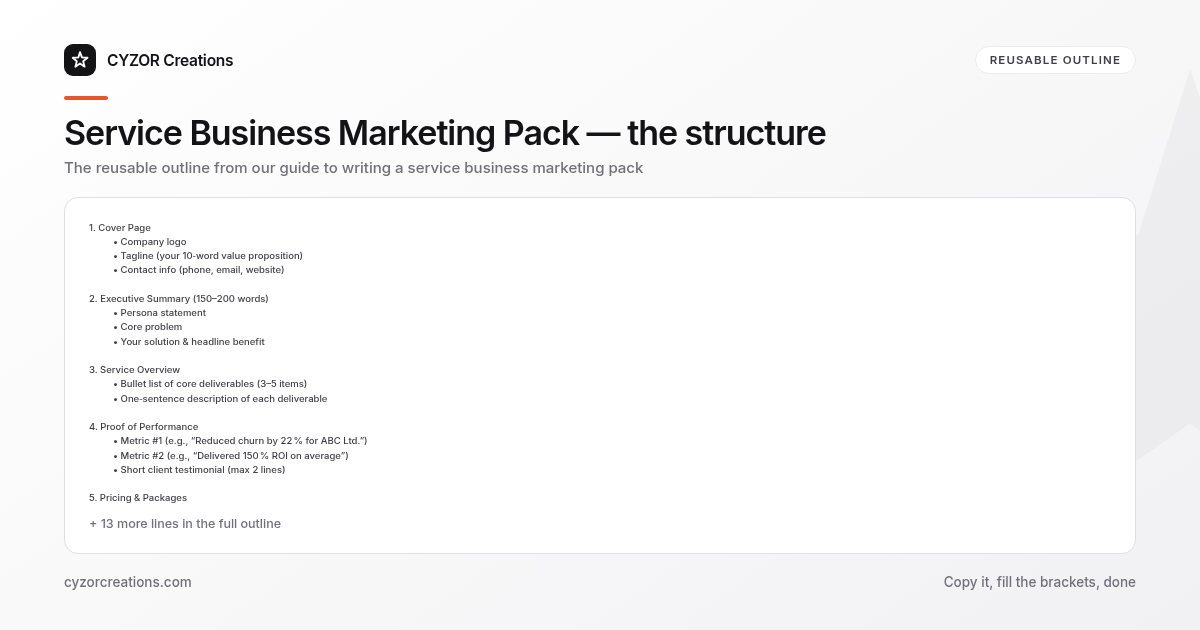
Below is a reusable outline you can copy into a Word or Google document. Replace bracketed placeholders with your own content.
1. Cover Page
 • Company logo
 • Tagline (your 10‑word value proposition)
 • Contact info (phone, email, website)

2. Executive Summary (150–200 words)
 • Persona statement
 • Core problem
 • Your solution & headline benefit

3. Service Overview
 • Bullet list of core deliverables (3–5 items)
 • One‑sentence description of each deliverable

4. Proof of Performance
 • Metric #1 (e.g., “Reduced churn by 22 % for ABC Ltd.”)
 • Metric #2 (e.g., “Delivered 150 % ROI on average”)
 • Short client testimonial (max 2 lines)

5. Pricing & Packages
 • Tier 1 – Basic (price, included services, expected ROI)
 • Tier 2 – Premium (price, added services, expected ROI)
 • Optional à la carte add‑ons

6. Implementation Timeline
 • Phase 1 – Discovery (1 week)
 • Phase 2 – Deployment (2–4 weeks)
 • Phase 3 – Review & Optimization (ongoing)

7. Next Steps
 • CTA (schedule call, request proposal, etc.)
 • Calendar link or QR code (optional)
 • Signature line for quick acceptance
Keep the total page count between 2 and 4 pages (single‑sided). Anything longer risks losing the reader’s attention.
Common Mistakes to Avoid
- Overloading with industry jargon – the reader may not share your acronyms; replace them with plain language.
- Leaving gaps in the narrative – every claim needs a supporting fact; a bold statement without evidence erodes credibility.
- Using generic stock photos – they dilute authenticity; a single real client photo or a clean icon set is sufficient.
- Mixing multiple CTAs – “Call us,” “download the brochure,” and “sign up for a trial” confuse the prospect; choose one primary action.
- Neglecting mobile readability – many prospects view PDFs on phones; ensure font size is at least 11 pt and margins are wide enough to avoid horizontal scrolling.
A Short Example
> Cover
> BrightPath Consulting – “Cut IT support costs by half within 90 days.”
>
> Executive Summary
> Operations directors in midsize manufacturers often spend 12 % of revenue on reactive IT support. BrightPath replaces ad‑hoc tickets with a proactive monitoring platform, delivering a $120 k cost reduction in the first year for a typical client.
>
> Service Overview
> - Proactive Monitoring – 24/7 alerts on critical systems.
> - Ticket Consolidation – One portal, single SLA.
> - Quarterly Optimization – Review and adjust settings for continuous savings.
>
> Proof
> Saved $120 k in Year 1 for XYZ Manufacturing (30 % cost reduction).
> Client quote: “We finally stopped firefighting and focused on growth.”
>
> Pricing
> Starter – $9,500 (first‑year monitoring, quarterly reviews).
> Growth – $15,800 (includes on‑site quarterly workshops).
>
> Next Steps
> Book a 30‑minute discovery call: 555‑123‑4567 or hello@brightpath.com.
The excerpt fits on a single page, yet it communicates problem, solution, proof, price, and a clear next step.
Pro Tips
- Version for each buyer stage – create a “quick‑look” one‑pager for early‑stage leads and a full‑detail pack for decision‑makers. The core content stays the same; only depth changes.
- Use a single brand color for CTAs – a consistent hue draws the eye to the action you want them to take without distracting from the body copy.
- Embed a QR code that links to a short video case study – the code takes up minimal space but adds a dynamic proof element for tech‑savvy prospects.
- Run a 30‑second “elevator pitch” test – after drafting, read the entire pack aloud in half a minute. If you can’t convey the value proposition, trim the fluff.
- Store the template in a shared folder with version control – this prevents multiple drafts from circulating and ensures every team member pulls the latest pricing and proof points.
With a disciplined approach, a marketing pack becomes a repeatable asset rather than a one‑off chore. Follow the steps and stick to the outline, and you will have a short document you can put in front of a prospect.