Why a Referral Program Matters – and What Trips People Up
Referral programs turn your happiest customers into salespeople without a payroll. A well‑crafted program can lower acquisition cost and increase lifetime value because people tend to trust friends more than ads.
What most people stumble on isn’t the idea itself; it’s the execution. They either overcomplicate the reward structure, forget to embed tracking into the user flow, or write copy that sounds like a generic coupon. The result is a half‑finished incentive that never gets used, or worse, a program that creates legal headaches.
Step by Step
- Define the Business Goal
- Is the aim to acquire 500 new users in the next quarter, increase average order value, or grow subscriptions that stick?
- Write the goal as a measurable KPI (e.g., “Add 2,000 qualified leads by 30 Sept”). This will shape the reward size and eligibility rules.
- Choose the Reward Model
- Dual‑sided – both referrer and referee get a benefit (e.g., $10 credit each).
- One‑sided – only the referrer receives a reward (e.g., 20 % of the first purchase).
- Tiered – rewards increase after a certain number of successful referrals (e.g., 5 % after 1 referral, 10 % after 5).
- Pick the model that aligns with your goal and profit margin. Run a quick spreadsheet: Reward × Expected Conversions ≤ Target CAC.
- Map the Referral Journey
- Sketch the user flow: sign‑in → “Invite friends” button → share link → referee clicks → sign‑up → conversion → reward trigger.
- Identify friction points (e.g., requiring a manual code entry) and eliminate them. The smoother the path, the higher the completion rate.
- Set Eligibility & Fraud Controls
- Decide who can refer (existing customers, employees, partners) and who can be referred (new email domains, geographic limits).
- Implement basic safeguards: limit referrals per user per month, require the referee to complete a qualifying action (purchase, subscription), and flag duplicate IPs or email patterns.
- Write the Copy & Visual Assets
- Headline: “Give $10, Get $10” (clear, benefit‑first).
- Body: Explain why the reward exists, the steps, and any expiration (“Rewards are credited within 48 h of the referee’s first purchase”).
- Use a single call‑to‑action button (“Invite Now”) and a shareable link that auto‑populates a pre‑written message for email, SMS, or social.
- Build Tracking & Reporting
- Generate a unique referral token for each user (e.g.,
ref=USER123). - Store the token in a cookie or local storage to attribute the conversion even if the referee lands on a landing page first.
- Set up a dashboard that shows: total invites sent, conversion rate, reward payouts, and cost per acquisition.
- Generate a unique referral token for each user (e.g.,
- Launch, Test, and Iterate
- Run a soft launch with a 5 % segment of your user base.
- Measure key metrics for two weeks: invite click‑through, referral conversion, reward redemption latency.
- Adjust reward size, messaging, or eligibility based on the data before rolling out to the full audience.
A Simple Structure to Follow
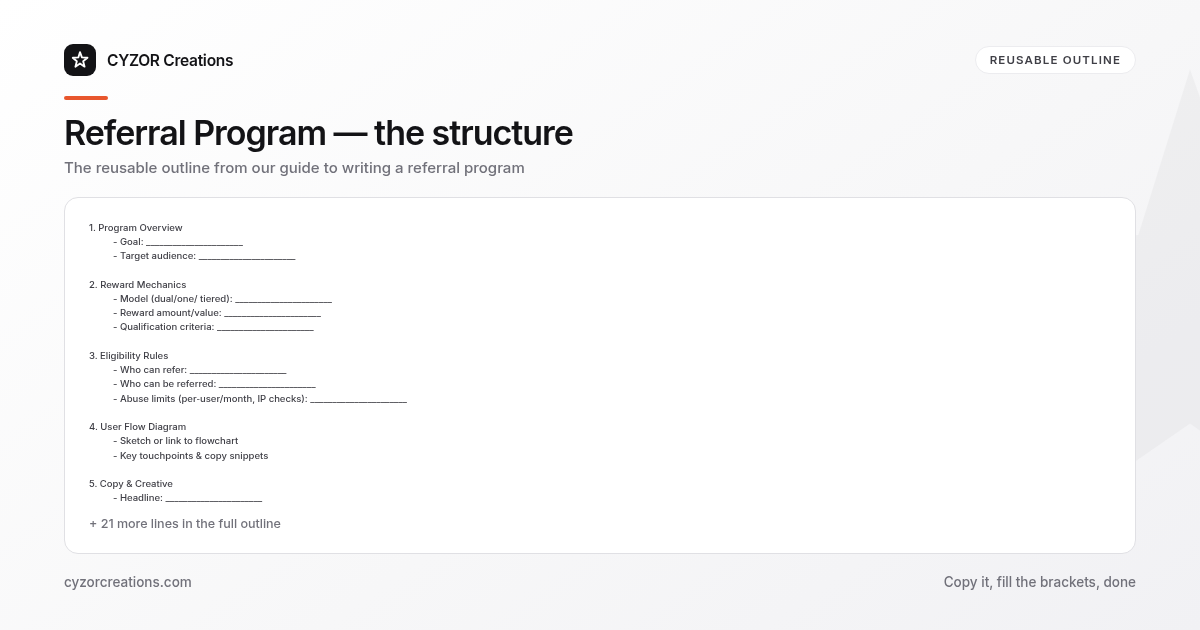
Below is a reusable outline you can copy into a Google Doc, Notion page, or internal wiki. Fill in each placeholder before moving to the next phase.
1. Program Overview
 - Goal: ______________________
 - Target audience: ______________________

2. Reward Mechanics
 - Model (dual/one/ tiered): ______________________
 - Reward amount/value: ______________________
 - Qualification criteria: ______________________

3. Eligibility Rules
 - Who can refer: ______________________
 - Who can be referred: ______________________
 - Abuse limits (per‑user/month, IP checks): ______________________

4. User Flow Diagram
 - Sketch or link to flowchart
 - Key touchpoints & copy snippets

5. Copy & Creative
 - Headline: ______________________
 - Body copy (max 150 words): ______________________
 - CTA text: ______________________
 - Visual assets (icons, banner dimensions): ______________________

6. Technical Implementation
 - Referral token format: ______________________
 - Storage method (cookie/local storage): ______________________
 - Backend trigger (event name, API endpoint): ______________________

7. Tracking & Reporting
 - KPI list (invites sent, conversion %, reward cost): ______________________
 - Dashboard tool & data source: ______________________

8. Launch Plan
 - Soft‑launch segment: ______________________
 - Test duration: ______________________
 - Success thresholds: ______________________

9. Legal & Compliance
 - Terms summary: ______________________
 - Opt‑out process: ______________________
Having this skeleton forces you to address every critical piece before you write a single line of copy.
Common Mistakes to Avoid
- Vague rewards – “Earn points” without stating the monetary equivalent confuses users.
- Hidden conditions – Tying the reward to a “minimum spend of $100” that appears only in fine print kills conversion.
- Manual steps – Requiring the referrer to copy‑paste a code; automation is a must.
- No expiration – Unlimited reward windows lead to accounting headaches and abuse.
- Neglecting legal language – Forgetting to disclose tax implications or data‑privacy terms can expose the business to risk.
A Short Example
> Headline: “Give $15, Get $15”
> Copy: “Share your unique link below. When a friend makes their first purchase of $50 or more, we’ll credit both of you $15. Rewards appear in your account within 48 hours. No caps, no catch—just thank‑you credits for spreading the word.”
> CTA: “Copy My Link & Invite”
The example follows the dual‑sided model, states the qualifying purchase amount, and promises a concrete timeline for reward delivery. It’s short enough to fit a modal window yet detailed enough to prevent confusion.
Pro Tips
- Align the reward with the product price – A $5 credit works for a $20 SaaS plan, but a $50 credit feels more appropriate for a $300 hardware purchase. Use a simple ratio (reward ≈ 5 %–10 % of average order value) as a starting point.
- Use social proof – Show a live counter (“John Doe just earned $15”) near the invite button. Real‑time numbers increase trust and motivate others to act.
- Automate the “thank you” email – As soon as the referee completes the qualifying action, trigger an email that includes the reward amount, a receipt, and a prompt to share again. The extra nudge often yields a second referral within days.
- Test two copy variations – Run an A/B test on the headline (“Give $10, Get $10” vs. “Earn $10 for Every Friend”) to see which phrasing drives higher click‑through. Small wording tweaks can meaningfully lift participation.
- Monitor churn of rewarded users – If a large share of referrers churn within 30 days, the program may be attracting price‑sensitive customers. Adjust the reward or tighten eligibility to protect long‑term profitability.
With the steps, template and cautionary notes above, you have what you need to design a referral program that is easy to join and tracks cleanly for the business. Start filling out the outline, run a quick pilot, and watch the network effect take shape.