Why a launch announcement matters – and why it trips people up
A launch announcement is the first public handshake between your new offering and the world. It sets expectations, builds momentum, and gives journalists, partners, and early adopters a clear story to share. Most people stumble because they try to cram every detail into one blurb, or they assume the audience already knows why the launch is important. The result is a vague, noisy message that gets ignored. A focused announcement, on the other hand, tells a single story, highlights the biggest benefit, and provides the exact next steps for the reader.
Step by Step
- Define the core news – Write a one‑sentence summary that answers “What exactly is launching?” and “Why does it matter right now?” If you can’t say it in 15 words, you’re still mixing in secondary details.
- Identify the target audience – List the primary groups (e.g., customers, press, investors, partners). For each group note the one piece of information they need to act on.
- Gather supporting facts – Pull three concrete data points: a launch date, a performance metric, and a quote from a stakeholder. Numbers anchor credibility; a quote adds a human voice.
- Draft the headline – Use the core news plus a benefit. Keep it under 12 words and make the benefit measurable (e.g., “Reduce onboarding time by 40%”).
- Write the lead paragraph – Follow the “who, what, when, where, why, how” formula, but prioritize the benefit. The first 2‑3 sentences should answer the audience’s most pressing question.
- Add the body – Expand on the three supporting facts, embed a short quote, and include a call‑to‑action (CTA) that tells readers exactly what to do next (visit a URL, register for a demo, etc.).
- Polish for clarity – Read the draft aloud. Remove any jargon, duplicate adjectives, or passive constructions. Aim for a reading level equivalent to a high‑school sophomore; the announcement should be skim‑friendly.
A Simple Structure to Follow
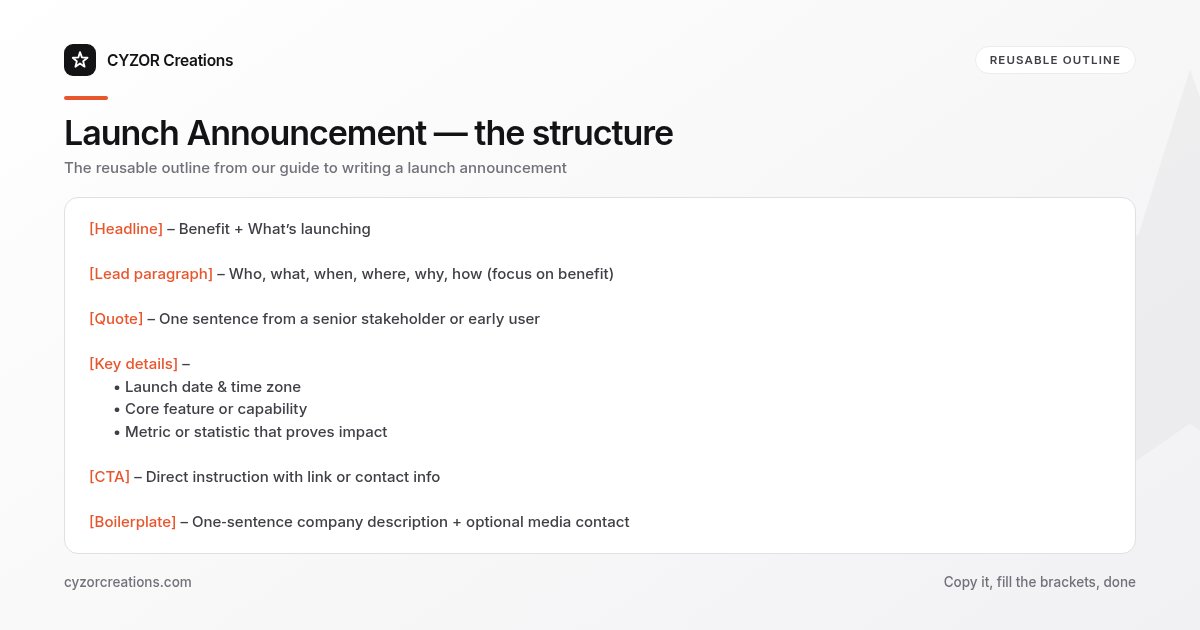
[Headline] – Benefit + What’s launching

[Lead paragraph] – Who, what, when, where, why, how (focus on benefit)

[Quote] – One sentence from a senior stakeholder or early user

[Key details] –
   • Launch date & time zone
   • Core feature or capability
   • Metric or statistic that proves impact

[CTA] – Direct instruction with link or contact info

[Boilerplate] – One‑sentence company description + optional media contact
Why this works: The headline grabs attention; the lead paragraph confirms relevance; the quote adds authority; the bullet list makes facts scannable; the CTA removes ambiguity; the boilerplate gives context for journalists.
Common Mistakes to Avoid
- Overloading the headline with multiple benefits or product jargon.
- Leaving out a clear CTA; readers should never wonder what to do next.
- Using passive voice (“The feature was released”) which dilutes urgency.
- Repeating the same benefit in every paragraph; it makes the copy feel padded.
- Forgetting the “why now” angle; without a time‑sensitive hook the news feels optional.
A Short Example
> Headline: “Acme Analytics launches real‑time dashboard that cuts reporting time by 50%”
>
> Lead: “Today, Acme Analytics rolls out its new real‑time dashboard, enabling finance teams to generate month‑end reports in half the usual time. The web‑based tool goes live at 09:00 UTC on 15 July and is instantly available to all existing customers.”
>
> Quote: “Our clients have told us that speed is the biggest barrier to actionable insights,” said Maya Patel, VP of Product. “This release removes that barrier entirely.”
>
> Key details:
> • Launch date: 15 July 2026, 09:00 UTC
> • Core capability: live data sync across ERP, CRM, and HR systems
> • Proven impact: beta testers reported a 48% reduction in reporting cycle time
>
> CTA: “Log in to your Acme Analytics account now to activate the dashboard, or request a live walkthrough at demo.acme.com.”
>
> Boilerplate: “Acme Analytics provides cloud‑based business intelligence solutions to mid‑size enterprises worldwide. Media inquiries: press@acme.com.”
Pro Tips
- Test the headline with three colleagues before publishing. If any of them can’t summarize the benefit in one sentence, rewrite it.
- Anchor the announcement to a news hook (e.g., an industry conference, a regulatory deadline, or a seasonal trend) to increase pickup by journalists.
- Include a one‑pager PDF as a downloadable asset; it lets reporters copy facts without re‑typing.
- Schedule the release for a low‑traffic hour in your primary market (usually early morning on a Tuesday) to avoid inbox overload and improve open rates.
- Track three metrics after launch: open rate, click‑through rate on the CTA, and earned media mentions. Use the data to refine the next announcement’s tone and timing.