Why a SWOT analysis matters – and where people stumble
A SWOT analysis (Strengths, Weaknesses, Opportunities, Threats) is a compact way to surface the internal and external factors that shape a project, a department, or an entire organization. When you can see the four quadrants side by side, you stop guessing and start planning with evidence.
Most practitioners get stuck at two points: they either list everything that comes to mind without filtering, or they end up with vague statements that never translate into action. The former creates information overload; the latter yields a document that looks impressive but drives no decisions.
Step by Step
- Define the scope and timeframe
- Write a one‑sentence purpose (e.g., “Assess the market position of our flagship product for the next 12 months”).
- Agree on the boundaries: product line, business unit, geographic region, or a specific initiative.
- Gather data from three sources
- Internal documents: recent financial reports, customer satisfaction scores, employee surveys.
- External research: industry reports, competitor press releases, regulatory updates.
- Stakeholder interviews: talk to at least three people from different functions (e.g., sales, R&D, finance).
Capture each piece of information in a spreadsheet with columns for source, date, and relevance.
- Separate facts from interpretations
- Highlight raw data (e.g., “Revenue grew 8 % YoY”) in green.
- Write your interpretation (e.g., “Our pricing strategy is resonating with mid‑size firms”) in orange.
This step prevents bias from slipping into the SWOT matrix.
- Populate the four quadrants
- Strengths: internal capabilities that give you a competitive edge. Use verbs like “delivers,” “owns,” or “has.” Example: “Owns a patented low‑latency algorithm.”
- Weaknesses: internal gaps that hinder performance. Phrase them as deficiencies, not excuses. Example: “Lacks dedicated after‑sales support staff.”
- Opportunities: external trends you can exploit. Pair each with a concrete action. Example: “Emerging demand for edge‑AI devices → pilot a bundled offering.”
- Threats: external forces that could erode your position. Include a mitigation hint. Example: “New EU data‑privacy regulation → update compliance roadmap.”
- Prioritize within each quadrant
- Score each bullet on a 1‑5 scale for impact and likelihood.
- Multiply the two scores; the product becomes the priority index.
- Keep only the top three items per quadrant for the final report.
- Derive strategic implications
- For every high‑priority Strength, ask: “How can we leverage this to capture an Opportunity?”
- For each high‑priority Weakness, ask: “What Threat does this expose, and what quick fix can we apply?”
Write one sentence per pairing, e.g., “Our strong brand awareness (Strength) can be used to launch a co‑marketing campaign with a complementary SaaS partner (Opportunity).”
- Validate and finalize
- Circulate the draft matrix to the original interviewees and ask for a single round of feedback.
- Incorporate only factual corrections; do not add new items at this stage.
- Export the matrix as a one‑page PDF and attach a two‑page executive summary that lists the top‑five strategic actions.
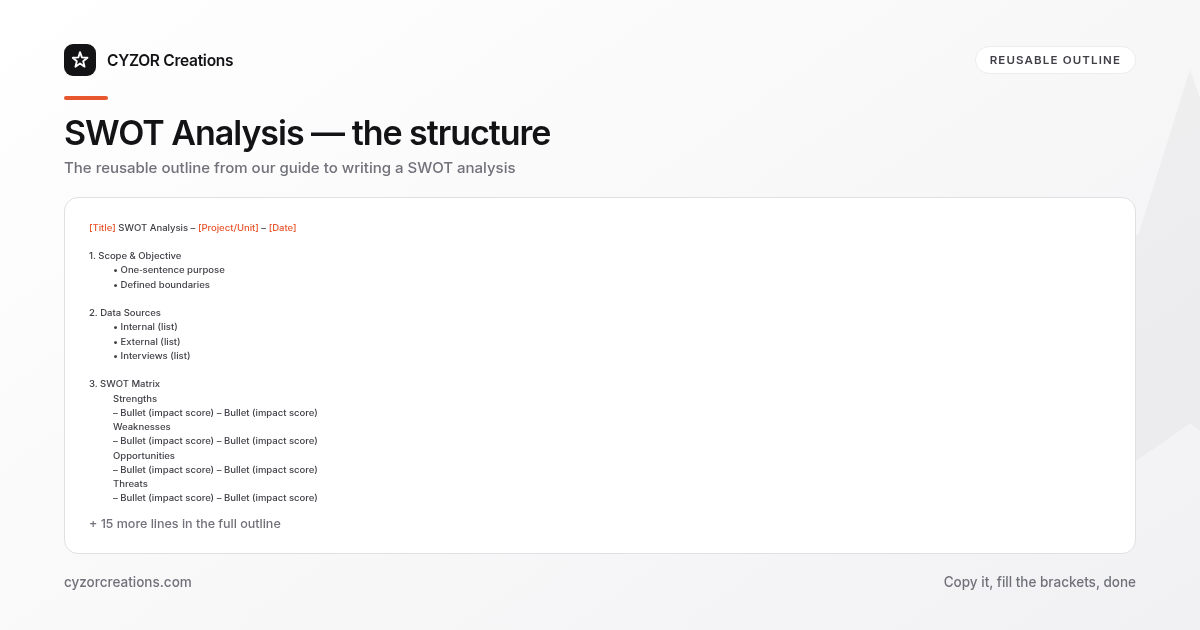
A Simple Structure to Follow
[Title] SWOT Analysis – [Project/Unit] – [Date]

1. Scope & Objective
 • One‑sentence purpose
 • Defined boundaries

2. Data Sources
 • Internal (list)
 • External (list)
 • Interviews (list)

3. SWOT Matrix
 Strengths
 – Bullet (impact score) – Bullet (impact score)
 Weaknesses
 – Bullet (impact score) – Bullet (impact score)
 Opportunities
 – Bullet (impact score) – Bullet (impact score)
 Threats
 – Bullet (impact score) – Bullet (impact score)

4. Prioritization Table
 • Item | Impact | Likelihood | Priority Index

5. Strategic Implications
 • Strength‑Opportunity pairing
 • Weakness‑Threat pairing
 • Actionable recommendation (who, what, by when)

6. Validation Log
 • Reviewer | Date | Comments

7. Executive Summary (max 300 words)
 • Top‑5 actions
 • Expected outcomes
Copy this outline into a new document and fill each section as you progress. The format forces you to keep the analysis concise and action‑oriented.
Common Mistakes to Avoid
- Listing everything – a bloated matrix hides the critical few. Stick to the top three items per quadrant after scoring.
- Mixing internal and external factors – keep the four boxes pure; otherwise the analysis loses its diagnostic power.
- Using vague language – “good reputation” is less useful than “brand recognized by 70 % of target buyers.”
- Skipping the prioritization step – without a numeric filter you cannot justify resource allocation.
- Failing to link to actions – a SWOT that ends with bullets is a dead end; always follow with at least one concrete initiative.
A Short Example
> Scope & Objective – Evaluate the competitive position of “EcoPrint” (our low‑cost, recycled‑paper printer) for the next fiscal year.
>
> SWOT Matrix
>
> Strengths
> – Proprietary ink‑reduction technology (Score 4 × 5 = 20)
> – Established distribution in office‑supply chains (Score 3 × 4 = 12)
>
> Weaknesses
> – Limited after‑sales service network (Score 2 × 3 = 6)
> – Production cost 8 % higher than main competitor (Score 3 × 4 = 12)
>
> Opportunities
> – Corporate sustainability mandates increasing demand for recycled‑paper devices (Score 5 × 4 = 20)
> – Emerging market in Southeast Asia with low‑price sensitivity (Score 4 × 3 = 12)
>
> Threats
> – New entrant offering a 15 % cheaper alternative (Score 4 × 5 = 20)
> – Upcoming EU packaging tax (Score 3 × 4 = 12)
>
> Strategic Implication – Leverage ink‑reduction technology (Strength) to launch a “green‑bundle” targeting firms with sustainability mandates (Opportunity).
>
> Action – Pilot the bundle in Q3 with the existing distribution partner; assign product manager Jane Doe, budget $150 k.
The example shows how a concise matrix, a priority index, and a single strategic sentence turn raw data into a decision‑ready plan.
Pro Tips
- Time‑box the data‑gathering phase – 48 hours for documents, 24 hours for interviews. A tight window forces you to focus on the most relevant sources.
- Use the “5‑Why” drill for each weakness – ask why the weakness exists, then why that cause matters, until you reach a root cause you can actually address.
- Create a “SWOT heat map” – plot each item on a 2‑axis chart (impact vs. likelihood). Visual clustering helps stakeholders spot the biggest risks at a glance.
- Re‑run the analysis after any major market event – a quarterly refresh captures new opportunities or threats before they become entrenched.
- Tie the SWOT to OKRs – map each top‑priority action to a specific Objective and its Key Result; this ensures accountability and measurable progress.