Writing a winning response to a Request for Proposal (RFP) is often the difference between landing a new contract and watching the opportunity slip away. Many teams stumble because they treat the RFP like a generic sales pitch, overlook the buyer’s specific criteria, or rush the submission until the deadline.
Step by Step
- Collect the full RFP package
- Download every attachment (scope, evaluation matrix, terms, and any addenda).
- Create a dedicated folder on your drive; name it
RFP_[Client]_[Date]. - Print a one‑page “quick‑look” checklist that lists required sections, page limits, and submission format (PDF, Word, etc.).
- Read, annotate, and extract requirements
- Highlight every “must‑have” clause (e.g., “must provide 24‑hour support”).
- Build a two‑column table: Requirement | How we’ll meet it.
- Flag any ambiguous points and draft clarification questions for the client’s contact. Ask no later than the “questions due” date.
- Map internal capabilities to each requirement
- Pull relevant case studies, metrics, and team bios from your knowledge base.
- For each requirement, note the exact evidence you’ll cite (e.g., “Reduced downtime by 32 % for XYZ Corp, 2023”).
- If a gap exists, decide whether to propose a mitigation plan or to omit that section (only if the RFP permits “alternative solutions”).
- Draft the response using the template (see next section)
- Fill in each placeholder with concise, data‑driven prose.
- Keep sentences under 20 words where possible; use active voice.
- Insert tables, charts, or timelines only if the RFP explicitly asks for them.
- Review for compliance and readability
- Run a compliance checklist: page count, required signatures, font size, and file naming convention.
- Perform a “read‑aloud” test: a colleague should be able to summarize each paragraph in 10 seconds.
- Verify that every “must‑have” item appears at least once in the document.
- Polish the visual and editorial details
- Apply the client’s branding guidelines (logo placement, color palette) if provided.
- Use a consistent heading hierarchy (H2 for major sections, H3 for sub‑sections).
- Conduct a final spell‑check and ensure all hyperlinks open correctly.
- Submit and archive
- Upload the final PDF to the client’s portal before the deadline timestamp.
- Send a brief confirmation email to the procurement contact, attaching the submission receipt.
- Archive the folder with a version‑controlled name, e.g.,
RFP_[Client]_2024_07_v1.0, for future reference or audit.
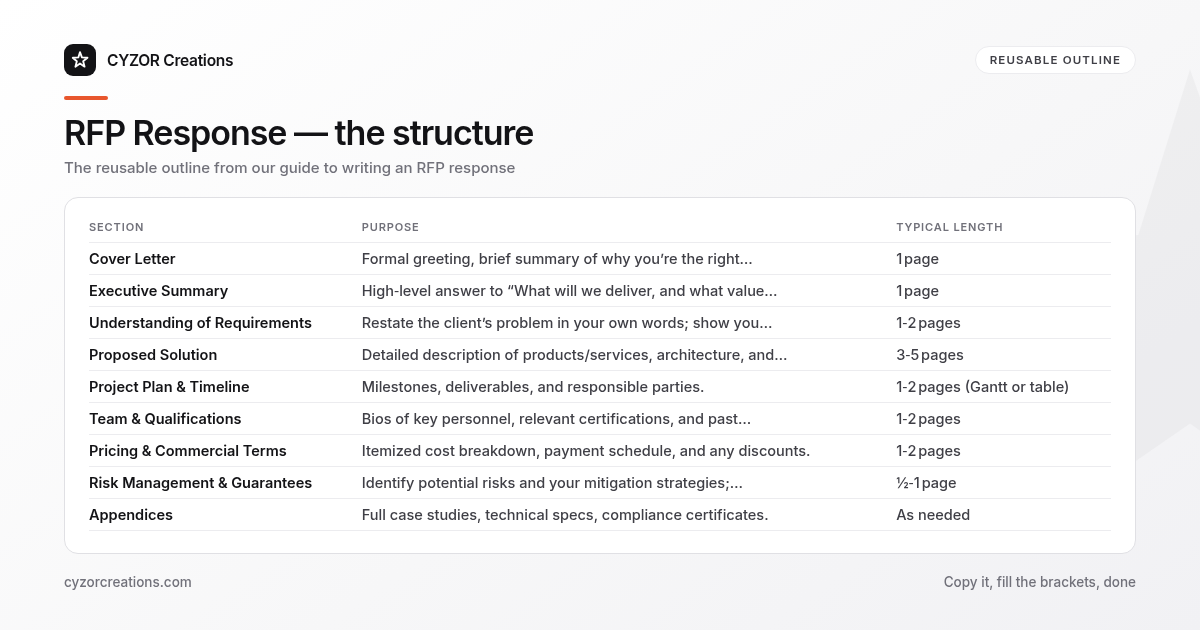
A Simple Structure to Follow
| Section | Purpose | Typical Length |
|---|---|---|
| Cover Letter | Formal greeting, brief summary of why you’re the right partner. | 1 page |
| Executive Summary | High‑level answer to “What will we deliver, and what value will you get?” | 1 page |
| Understanding of Requirements | Restate the client’s problem in your own words; show you listened. | 1‑2 pages |
| Proposed Solution | Detailed description of products/services, architecture, and workflow. | 3‑5 pages |
| Project Plan & Timeline | Milestones, deliverables, and responsible parties. | 1‑2 pages (Gantt or table) |
| Team & Qualifications | Bios of key personnel, relevant certifications, and past performance. | 1‑2 pages |
| Pricing & Commercial Terms | Itemized cost breakdown, payment schedule, and any discounts. | 1‑2 pages |
| Risk Management & Guarantees | Identify potential risks and your mitigation strategies; include service‑level guarantees. | ½‑1 page |
| Appendices | Full case studies, technical specs, compliance certificates. | As needed |
Tip: Keep the template as a master Word or Google document with placeholder text like [Insert client name] and [Insert metric]. Replace each placeholder during step 4.
Common Mistakes to Avoid
- Copy‑pasting without tailoring – Generic boilerplate looks lazy and often fails the “fit‑for‑purpose” test.
- Missing a mandatory attachment – Forgetting a signed NDA or a required financial statement can disqualify you instantly.
- Overloading the response with jargon – Acronyms that the client’s procurement team doesn’t understand create confusion.
- Exceeding page limits – Most RFPs enforce strict limits; extra pages are automatically trimmed.
- Leaving unanswered “must‑have” items – Even a single unchecked box can lower your score dramatically.
A Short Example
> Executive Summary
>
> XYZ Solutions proposes a phased migration to a hybrid cloud environment that will reduce your infrastructure cost by 18 % within the first 12 months. Our approach leverages proven automation scripts (see Appendix A) and includes 24 × 7 support covered under a Service Level Agreement guaranteeing 99.9 % uptime. The total contract value is $1.2 M, payable in quarterly installments, with a 5 % early‑payment discount.
> Understanding of Requirements
>
> You need a scalable platform that can handle peak loads of 2 million concurrent users while maintaining sub‑2‑second response times. Current on‑premise servers are at 75 % capacity, and you require a migration plan that does not interrupt the existing user base.
> Proposed Solution – Phase 1 (Month 1‑3): Deploy a load‑balancing layer using Azure Front Door; Phase 2 (Month 4‑6): Migrate core services to Azure Kubernetes Service; Phase 3 (Month 7‑9): Decommission legacy hardware and hand over operational documentation.
Pro Tips
- Ask clarifying questions early – A concise query that resolves a vague requirement often earns you extra points for diligence.
- Quantify every claim – Replace “high reliability” with “99.9 % uptime over the past 24 months, measured by independent monitoring.”
- Mirror the client’s language – If the RFP uses the term “service continuity,” use the same phrase in your response; it signals alignment.
- Include a “Value‑Add” box – A one‑line bullet that highlights an optional service (e.g., “free quarterly health check”) can tip the scales without inflating cost.
- Track version history – Tag each draft with a date and reviewer initials; this audit trail proves compliance if the client requests a post‑submission audit.
Follow the steps, respect the structure, and keep the focus on the client’s needs. A disciplined RFP response not only meets the checklist; it tells a clear story of how you will solve the problem, why you’re uniquely qualified, and what measurable benefit the client will see.