Why a solid investment analysis matters – and why many stumble
Investors, whether they manage a family office or a corporate treasury, rely on a written analysis to decide where to allocate capital. A well‑crafted document forces you to surface the assumptions that drive a deal, quantifies risk, and gives decision‑makers a common language. The hardest part for most analysts is moving from a pile of data points to a coherent narrative that answers three questions in one glance:
- What is the opportunity?
- Is the return worth the risk?
- What must happen for the thesis to hold?
If you can answer those questions clearly, the rest of the process—presentation, negotiation, monitoring—becomes far smoother.
Step by Step
- Define the scope and audience
- Write a one‑sentence purpose statement (e.g., “Assess the viability of acquiring XYZ Corp for a strategic foothold in the renewable‑energy market”).
- List the primary readers (CFO, investment committee, board). Knowing who will read it determines the depth of financial detail and the tone of the narrative.
- Gather and verify data
- Pull the latest audited financials, management forecasts, and market research.
- Cross‑check key inputs (revenue growth, margin trends, capex) against at least two independent sources—company filings and third‑party analyst reports.
- Document every source in a “Data Sources” table; this saves time when reviewers ask for provenance.
- Build a base‑case financial model
- Use a simple three‑statement model (income, balance sheet, cash flow) with a 5‑year horizon.
- Include a discounted cash flow (DCF) calculation: forecast free cash flow, choose a weighted‑average cost of capital (WACC), and compute net present value (NPV).
- Keep assumptions in a separate “Assumptions” sheet so they can be tweaked without breaking formulas.
- Stress‑test the model
- Create at least three scenarios: Base, Downside (e.g., 20 % lower revenue growth), and Upside (e.g., 15 % higher margin).
- Record the resulting NPV, internal rate of return (IRR), and payback period for each scenario.
- Highlight the variables that move the needle most (sensitivity analysis).
- Translate numbers into a narrative
- Start with a concise “Investment Thesis” paragraph that ties the quantitative upside to a strategic rationale.
- Follow with a “Key Drivers” bullet list that references the most sensitive model inputs.
- End the narrative section with a “Deal Breakers” list—conditions that would invalidate the thesis (regulatory change, loss of a major customer, etc.).
- Draft the risk‑return matrix
- Use a 2 × 2 grid: Likelihood (high/low) on the Y‑axis, Impact (high/low) on the X‑axis.
- Populate each quadrant with the top three risks, and note mitigation actions (e.g., “hedge commodity exposure” or “secure a long‑term supply contract”).
- Polish and package
- Insert a table of contents with page numbers for easy navigation.
- Apply consistent formatting: headings in bold, numbers right‑aligned, currency in USD millions.
- Add a one‑page “Executive Summary” that can be read in under two minutes.
A Simple Structure to Follow
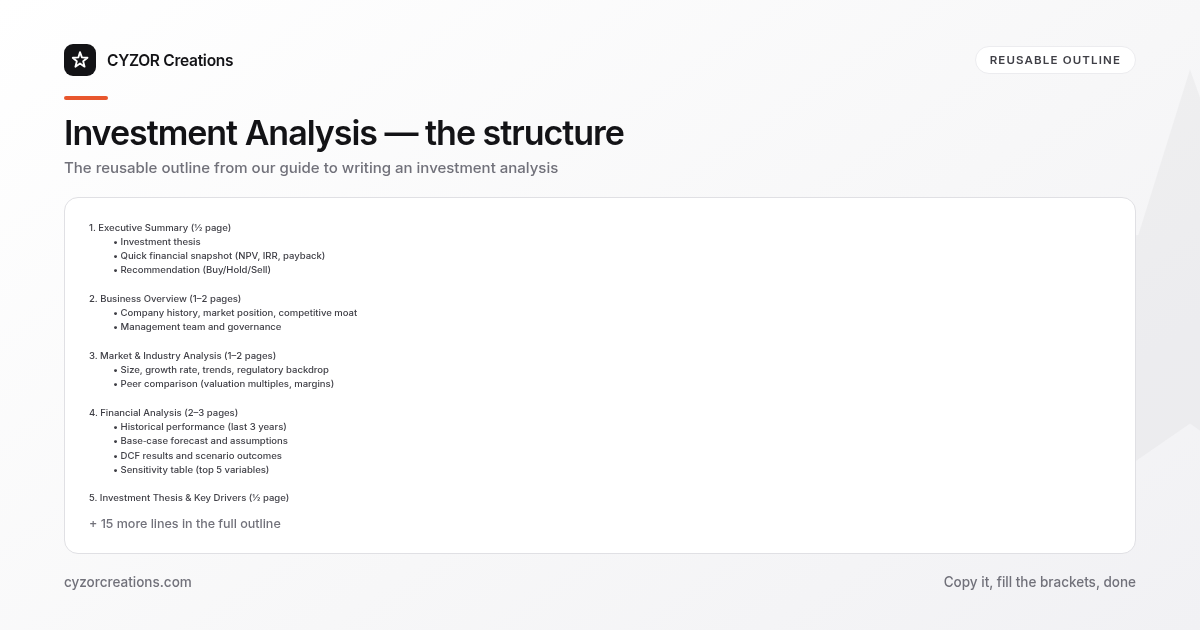
1. Executive Summary (½ page)
 • Investment thesis
 • Quick financial snapshot (NPV, IRR, payback)
 • Recommendation (Buy/Hold/Sell)

2. Business Overview (1–2 pages)
 • Company history, market position, competitive moat
 • Management team and governance

3. Market & Industry Analysis (1–2 pages)
 • Size, growth rate, trends, regulatory backdrop
 • Peer comparison (valuation multiples, margins)

4. Financial Analysis (2–3 pages)
 • Historical performance (last 3 years)
 • Base‑case forecast and assumptions
 • DCF results and scenario outcomes
 • Sensitivity table (top 5 variables)

5. Investment Thesis & Key Drivers (½ page)
 • Why the investment should generate excess returns
 • Drivers that most affect upside/downside

6. Risks & Mitigants (½ page)
 • List of 5–7 material risks
 • Corresponding mitigation strategies

7. Deal Structure & Next Steps (½ page)
 • Proposed transaction type (equity, debt, hybrid)
 • Timeline, required approvals, and immediate actions

8. Appendices
 • Full financial model (Excel)
 • Source list
 • Glossary of terms
Copy this outline into a new document and fill each heading with the content you generated in the step‑by‑step process. The template forces you to cover every critical angle without over‑loading the reader.
Common Mistakes to Avoid
- Skipping source verification. Relying on a single data point can hide a reporting error that later derails the analysis.
- Over‑complicating the model. Adding exotic calculations (e.g., Monte‑Carlo simulations) when a simple DCF suffices distracts reviewers.
- Mixing narrative tone with raw numbers. Readers expect a clear story; dumping tables in the middle of prose breaks flow.
- Neglecting downside scenarios. A bullish base case without a credible downside can appear naïve and invite pushback.
- Leaving the executive summary until the end. If you draft it first, you force yourself to keep the whole document focused on the core thesis.
A Short Example
> Executive Summary – We recommend acquiring 30 % of XYZ Corp for $120 million, delivering a base‑case IRR of 18 % and an NPV of $45 million over five years. The target operates a niche solar‑panel line that commands a 35 % gross margin, well above the industry average of 22 %. Our DCF assumes a 7 % WACC and a 5 % revenue CAGR, driven by expanding utility contracts in the Southwest.
> Key Drivers – (1) Continued growth in utility‑scale solar installations; (2) Ability to lock in raw‑material prices via long‑term contracts; (3) Retention of the current R&D team.
> Risks – (i) Policy shift reducing tax credits; (ii) Supply‑chain disruption for polysilicon; (iii) Execution risk in scaling production capacity. Mitigants include hedging a portion of material costs and securing a two‑year off‑take agreement with a regional utility.
The excerpt shows how the executive summary, key drivers, and risk sections can be compressed into a single, scan‑friendly block.
Pro Tips
- Anchor every quantitative claim to a source. A footnote like “(Source: SEC 10‑K, 2023)” lets reviewers verify numbers instantly and builds credibility.
- Use a “one‑page dashboard” for the financial model. Place NPV, IRR, and the three scenario outcomes side by side; this visual cue speeds up decision‑making.
- Write the recommendation in the first sentence of the executive summary. Decision‑makers often skim; placing the verdict up front prevents misinterpretation.
- Keep the language active and specific. Replace “The company may benefit from market growth” with “The company is projected to capture 4 % of the $3 billion market by 2028, adding $120 million in incremental revenue.”
- Schedule a 15‑minute “walk‑through” with the intended audience before finalizing. A quick verbal run‑through surfaces missing pieces and forces you to clarify jargon that may be obvious to you but not to the committee.